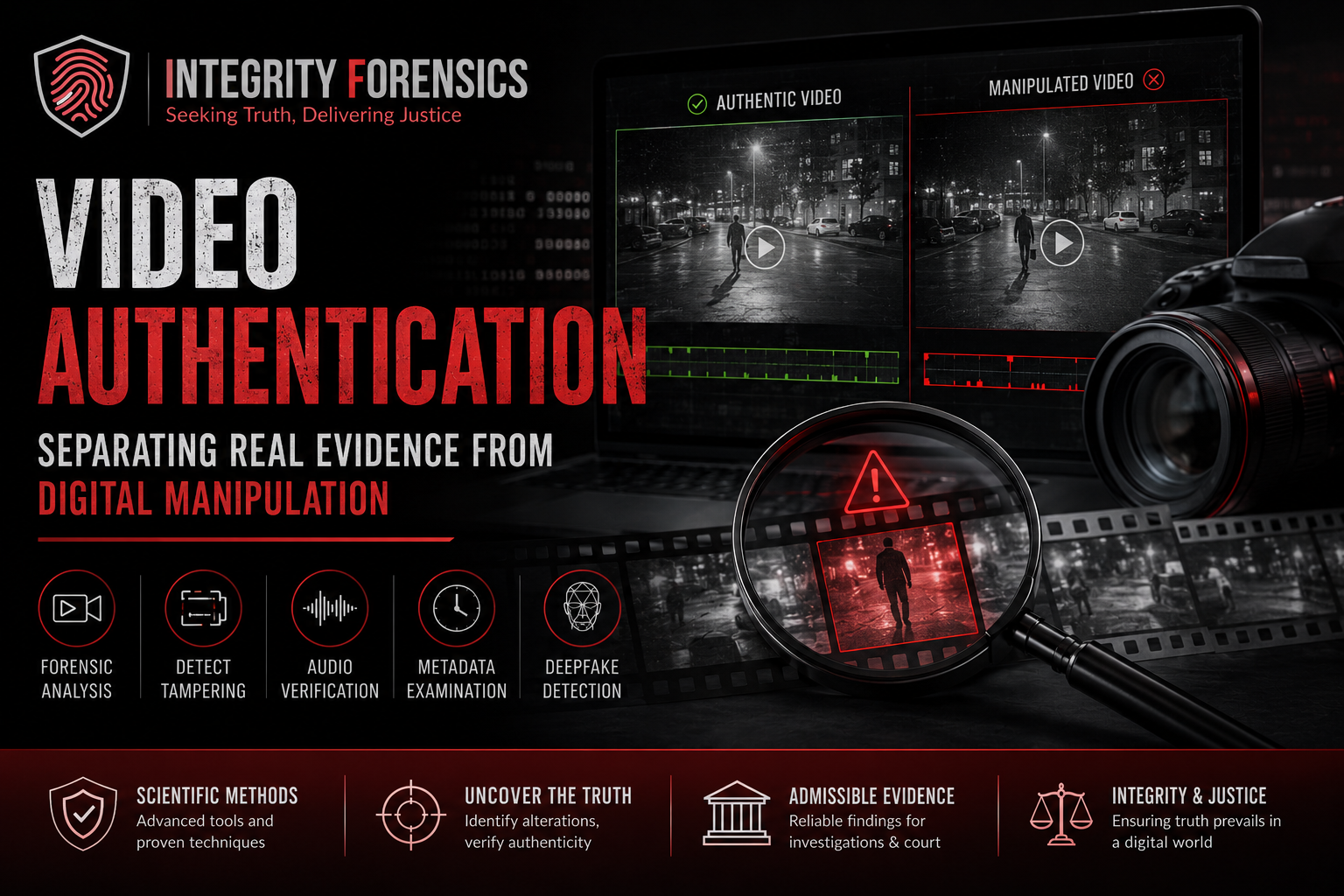
Video Authentication: Separating Real Evidence from Digital Manipulation
Introduction
In today’s digital era, video recordings have become one of the most powerful forms of evidence in criminal investigations, civil litigation, insurance claims, corporate inquiries, and courtroom proceedings. Whether captured through CCTV systems, mobile phones, body-worn cameras, dashboard cameras, or surveillance systems, videos are often regarded as objective representations of events. Many people believe that a video recording provides undeniable proof of what occurred at a particular place and time.
However, advancements in digital technology have fundamentally changed the reliability of visual evidence. Powerful video editing software, artificial intelligence tools, and deepfake technology have made it possible to alter, fabricate, or manipulate video content with remarkable realism. Today, individuals can remove objects from scenes, insert new elements, modify timestamps, alter audio tracks, and even create entirely synthetic videos that appear authentic to the human eye.
As a result, courts, investigators, organizations, and legal professionals can no longer rely solely on visual inspection when evaluating video evidence. This growing challenge has led to the increasing importance of forensic video authentication—a specialized branch of multimedia forensics dedicated to determining whether a video is genuine, altered, or artificially created.
Through scientific analysis and advanced examination techniques, forensic experts help separate authentic digital evidence from manipulated content, ensuring that decisions are based on facts rather than deception.
Understanding Video Authentication
Video authentication refers to the scientific examination of a video recording to determine its originality, integrity, and reliability as evidence.
The objective of video authentication is to answer critical questions such as:
- Is the video original?
- Has the video been edited or manipulated?
- Were any frames inserted or removed?
- Has the audio been altered?
- Is the timestamp genuine?
- Was artificial intelligence used to create or modify the content?
Unlike ordinary viewing, forensic video authentication involves a detailed technical analysis of the video file itself. Experts examine both visible characteristics and hidden digital information embedded within the recording to identify signs of tampering.
The process combines knowledge of digital media, computer science, image processing, and forensic methodology to establish whether a video accurately represents reality.
Why Video Authentication Is Important
Digital video evidence plays a significant role in modern investigations and legal proceedings.
Criminal Investigations
Video recordings frequently assist investigators in:
- Identifying suspects
- Establishing timelines
- Reconstructing events
- Corroborating witness statements
- Verifying alibis
In many criminal cases, video evidence becomes one of the most influential forms of proof presented before a court.
Civil Litigation
Video evidence is commonly used in:
- Property disputes
- Contractual disagreements
- Workplace investigations
- Personal injury claims
Authenticating such recordings is essential to ensure fairness and accuracy during legal proceedings.
Insurance Claims
Insurance fraud investigations often rely on video recordings to verify claims involving:
- Motor vehicle accidents
- Property damage
- Workplace incidents
- Personal injury claims
A manipulated video can significantly influence the outcome of an insurance dispute.
Corporate Investigations
Organizations use surveillance footage to investigate:
- Employee misconduct
- Theft
- Security breaches
- Workplace violence
- Compliance violations
Forensic authentication ensures that corporate decisions are based on reliable evidence.
The Growing Threat of Digital Manipulation
Video manipulation is no longer restricted to highly skilled professionals.
Modern editing tools allow users to perform sophisticated alterations with minimal technical expertise. Common forms of manipulation include:
- Cropping and trimming
- Frame deletion
- Frame insertion
- Audio replacement
- Timestamp modification
- Object removal
- Scene compositing
- Deepfake generation
These techniques can alter the interpretation of events and create misleading evidence capable of influencing investigations and judicial outcomes.
Common Types of Video Manipulation
Frame Deletion
Frame deletion involves removing selected frames from a recording.
This technique is often used to:
- Conceal actions
- Shorten timelines
- Hide evidence
- Remove individuals from a sequence
Even the deletion of a few frames can significantly change the interpretation of an event.
Frame Insertion
In frame insertion, additional frames are added to a video.
The purpose may be to:
- Create false actions
- Alter movement patterns
- Fabricate events
- Modify timelines
Such manipulations can be difficult to detect without forensic examination.
Video Splicing
Splicing involves combining segments from different recordings into a single video.
A spliced video may appear authentic while actually representing events that never occurred in the depicted sequence.
Timestamp Manipulation
Many investigations rely on timestamps to establish chronology.
Fraudsters may modify timestamps to:
- Create false alibis
- Support fraudulent claims
- Misrepresent event timing
Forensic experts carefully examine timestamps and related metadata to identify inconsistencies.
Audio Manipulation
Video manipulation is not limited to visuals.
Audio tracks may be:
- Edited
- Replaced
- Enhanced selectively
- Combined with other recordings
Such modifications can alter context and meaning.
Deepfakes: A New Challenge for Digital Forensics
One of the most significant threats to video authenticity is the emergence of deepfake technology.
Deepfakes are synthetic videos created using artificial intelligence and machine learning algorithms. These systems can generate highly realistic content showing individuals saying or doing things that never actually occurred.
Deepfake technology can:
- Replace faces
- Replicate voices
- Mimic facial expressions
- Generate entirely artificial videos
Although the technology has legitimate applications in entertainment and education, it is increasingly being exploited for fraud, misinformation, identity theft, and reputational damage.
The rapid advancement of deepfake technology has made forensic video authentication more important than ever before.
The Forensic Video Authentication Process
Evidence Collection
The authentication process begins with obtaining the original recording whenever possible.
Experts prioritize:
- Native video files
- Original storage devices
- Uncompressed recordings
Original evidence contains valuable forensic artifacts that may be lost during copying or transmission.
Evidence Preservation
Maintaining evidence integrity is essential.
Forensic professionals:
- Create forensic duplicates
- Generate hash values
- Maintain chain of custody
- Prevent accidental modification
These procedures ensure that evidence remains legally admissible.
Metadata Examination
Metadata is information embedded within a video file.
It may include:
- Device information
- Creation date
- Modification date
- GPS data
- File format details
- Software history
Metadata inconsistencies frequently provide important clues regarding manipulation.
Frame-by-Frame Analysis
A video consists of thousands of individual frames.
Experts examine each frame for:
- Missing frames
- Duplicated frames
- Abrupt transitions
- Motion inconsistencies
- Visual artifacts
Frame-level examination often reveals tampering that is impossible to detect during normal playback.
Compression Analysis
Digital videos undergo compression during storage and sharing.
Editing frequently introduces unusual compression patterns that can indicate manipulation.
Experts analyze:
- Encoding structures
- Compression artifacts
- Quantization inconsistencies
- Recompression indicators
These characteristics help identify whether a video has been altered.
Audio Authentication
The audio component is examined separately.
Experts assess:
- Voice continuity
- Background sounds
- Synchronization
- Editing artifacts
Audio analysis often reveals manipulations that remain undetected in the visual portion of the recording.
Detecting Deepfakes
Forensic experts use specialized techniques to identify AI-generated content.
These include:
Facial Analysis
Deepfakes often contain subtle abnormalities involving:
- Eye movement
- Blinking patterns
- Facial symmetry
- Expression consistency
Lighting Examination
Artificially generated faces may display lighting that does not match the surrounding environment.
Biological Signal Analysis
Researchers increasingly analyze physiological indicators such as blood-flow patterns and micro-expressions that are difficult for AI systems to replicate accurately.
AI-Based Detection Tools
Machine learning systems are now used to identify patterns associated with synthetic media generation.
These tools continue to evolve alongside deepfake technology.
Challenges in Video Authentication
Despite technological advancements, forensic video authentication presents several challenges.
Poor Video Quality
Low-resolution footage may obscure important forensic indicators.
Multiple Recompressions
Repeated sharing across platforms often alters the original file structure.
Missing Original Files
Investigators frequently receive copies rather than original recordings.
Sophisticated Editing Techniques
Modern editing tools continue to become more advanced and accessible.
Rapid Evolution of Artificial Intelligence
Deepfake technology evolves continuously, requiring forensic experts to update methodologies and tools regularly.
The Role of Video Authentication in Court
Courts increasingly rely on digital evidence.
However, before video evidence can be trusted, its authenticity must be established.
Forensic video experts assist courts by:
- Conducting scientific examinations
- Preparing detailed reports
- Presenting technical findings
- Providing expert testimony
- Explaining forensic conclusions
Their work helps ensure that judicial decisions are based on reliable and authentic evidence.
Future of Video Authentication
The future of video authentication is closely tied to technological innovation.
Emerging developments include:
- AI-assisted forensic analysis
- Advanced deepfake detection systems
- Blockchain-based evidence verification
- Automated authenticity assessment
- Enhanced metadata validation techniques
These advancements will strengthen the ability of forensic experts to combat increasingly sophisticated forms of digital manipulation.
Conclusion
Video evidence has become one of the most influential forms of proof in modern investigations and legal proceedings. Yet, the rise of digital editing tools, synthetic media, and deepfake technology has created unprecedented challenges regarding authenticity and trust.
Forensic video authentication provides a scientific framework for evaluating digital evidence. Through metadata examination, frame analysis, compression studies, audio authentication, and deepfake detection, forensic experts uncover signs of manipulation and establish whether a recording accurately represents reality.
In an era where digital content can be altered with remarkable precision, seeing is no longer always believing. Video authentication serves as a critical safeguard, helping investigators, courts, organizations, and individuals distinguish genuine evidence from deception and ensuring that truth remains at the center of justice.

