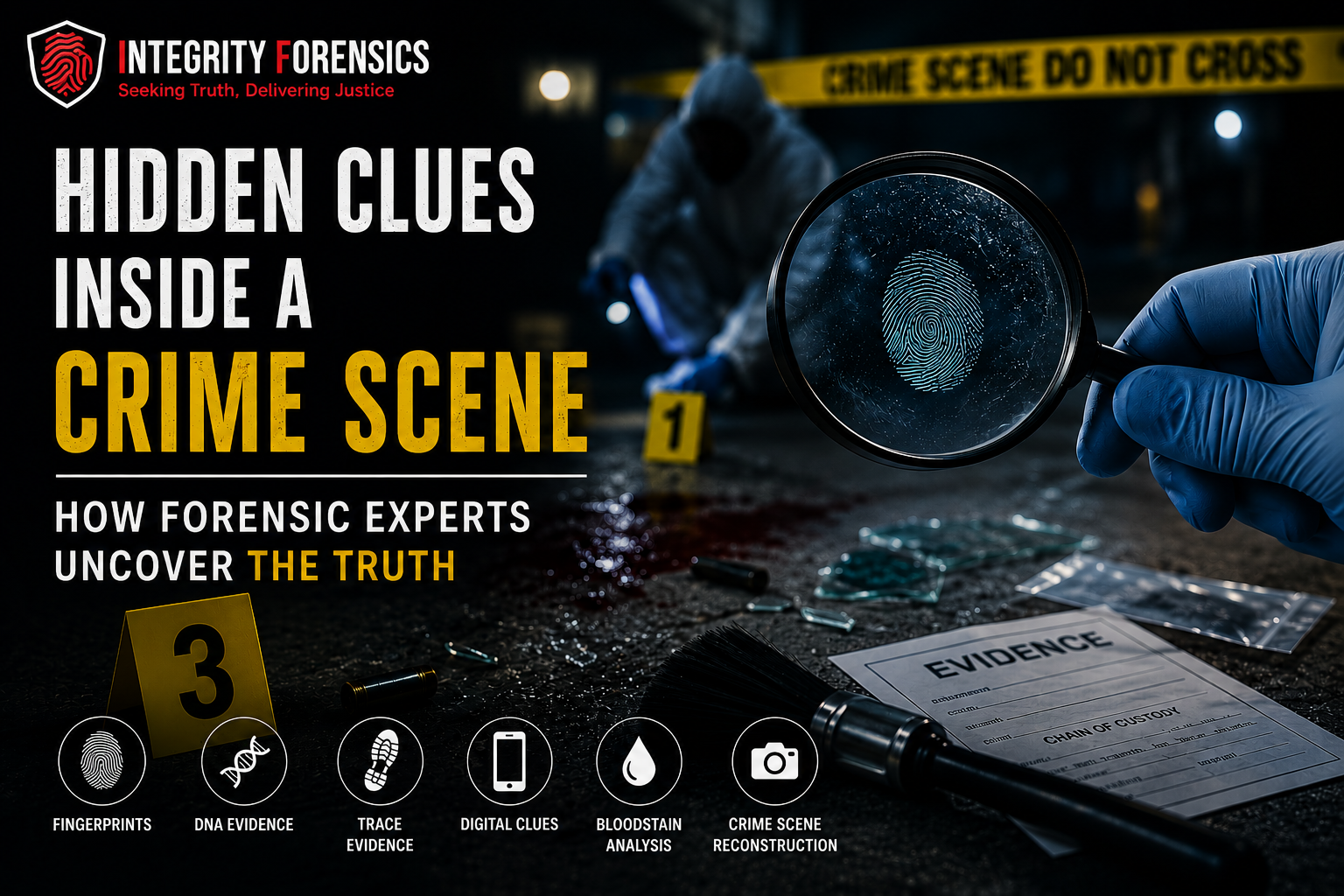
The Hidden Clues Inside a Crime Scene: How Forensic Experts Uncover the Truth
Introduction
At first glance, a crime scene may appear ordinary—a room, a vehicle, a public space, or even an empty stretch of road. However, to a forensic investigator, every crime scene is a silent witness holding valuable clues.
From a faint fingerprint on a glass surface to a strand of hair caught in a piece of fabric, seemingly insignificant details can play a critical role in uncovering what happened. Crime scenes often tell a story, but it takes careful observation, scientific analysis, and forensic expertise to interpret the evidence correctly.
The hidden clues left behind at a crime scene can help investigators establish timelines, identify suspects, verify witness statements, and reconstruct events with remarkable accuracy.
The Principle Behind Crime Scene Investigation
One of the most fundamental concepts in forensic science is Locard’s Exchange Principle, which states that whenever two objects come into contact, there is an exchange of material.
This means that individuals entering or leaving a crime scene may unknowingly leave traces of themselves behind while also taking traces from the scene with them. These traces can become powerful pieces of evidence when properly collected and analyzed.
Fingerprints: The Silent Identifiers
Fingerprints remain one of the most valuable forms of forensic evidence. Every person possesses unique ridge patterns, making fingerprints an effective tool for identification.
Investigators carefully examine surfaces such as doors, windows, mobile devices, furniture, and personal belongings for latent fingerprints. Even when invisible to the naked eye, specialized techniques can reveal these hidden impressions and connect individuals to a crime scene.
Biological Evidence and DNA
Tiny biological traces often become some of the strongest forms of evidence available during an investigation.
Examples include:
- Blood stains
- Saliva residues
- Hair strands
- Skin cells
- Sweat deposits
Modern DNA analysis allows forensic experts to develop detailed genetic profiles from extremely small samples. These profiles can assist in identifying victims, suspects, or unknown individuals connected to an incident.
Trace Evidence: Small Clues with Big Significance
Not all evidence is immediately visible. Microscopic materials can provide valuable investigative leads.
Trace evidence may include:
- Fibres from clothing
- Paint fragments
- Soil particles
- Glass shards
- Gunshot residue
Although these materials are often overlooked by the untrained eye, forensic scientists can use them to establish connections between people, locations, and objects involved in an investigation.
Digital Clues at Modern Crime Scenes
Today’s crime scenes frequently extend beyond physical locations.
Smartphones, computers, wearable devices, security systems, and online platforms generate digital footprints that can help investigators reconstruct events.
Digital evidence may reveal:
- Location history
- Communication records
- Internet activity
- Device usage patterns
- Time-stamped interactions
These digital traces often help establish timelines and verify or challenge statements made during an investigation.
Bloodstain Pattern Analysis
Bloodstains can reveal far more than the presence of an injury.
The size, shape, distribution, and direction of bloodstains may provide insights into the sequence of events, the type of force involved, and the positions of individuals at the scene.
By carefully examining blood patterns, forensic experts can contribute valuable information to crime scene reconstruction efforts.
The Importance of Proper Evidence Collection
Even the most significant clue can lose its value if it is improperly handled.
Forensic investigators follow strict protocols to document, collect, package, and preserve evidence while maintaining the chain of custody. These procedures help ensure that evidence remains reliable and admissible throughout the investigative and legal process.
Conclusion
Crime scenes rarely reveal their secrets immediately. The truth is often hidden within fingerprints, biological traces, microscopic particles, digital records, and countless other details that may go unnoticed by the average observer.
Through scientific methods and meticulous investigation, forensic experts transform these hidden clues into meaningful evidence. Every trace left behind has the potential to contribute to the reconstruction of events and bring investigators one step closer to the truth.
In forensic science, even the smallest clue can tell the biggest story.

