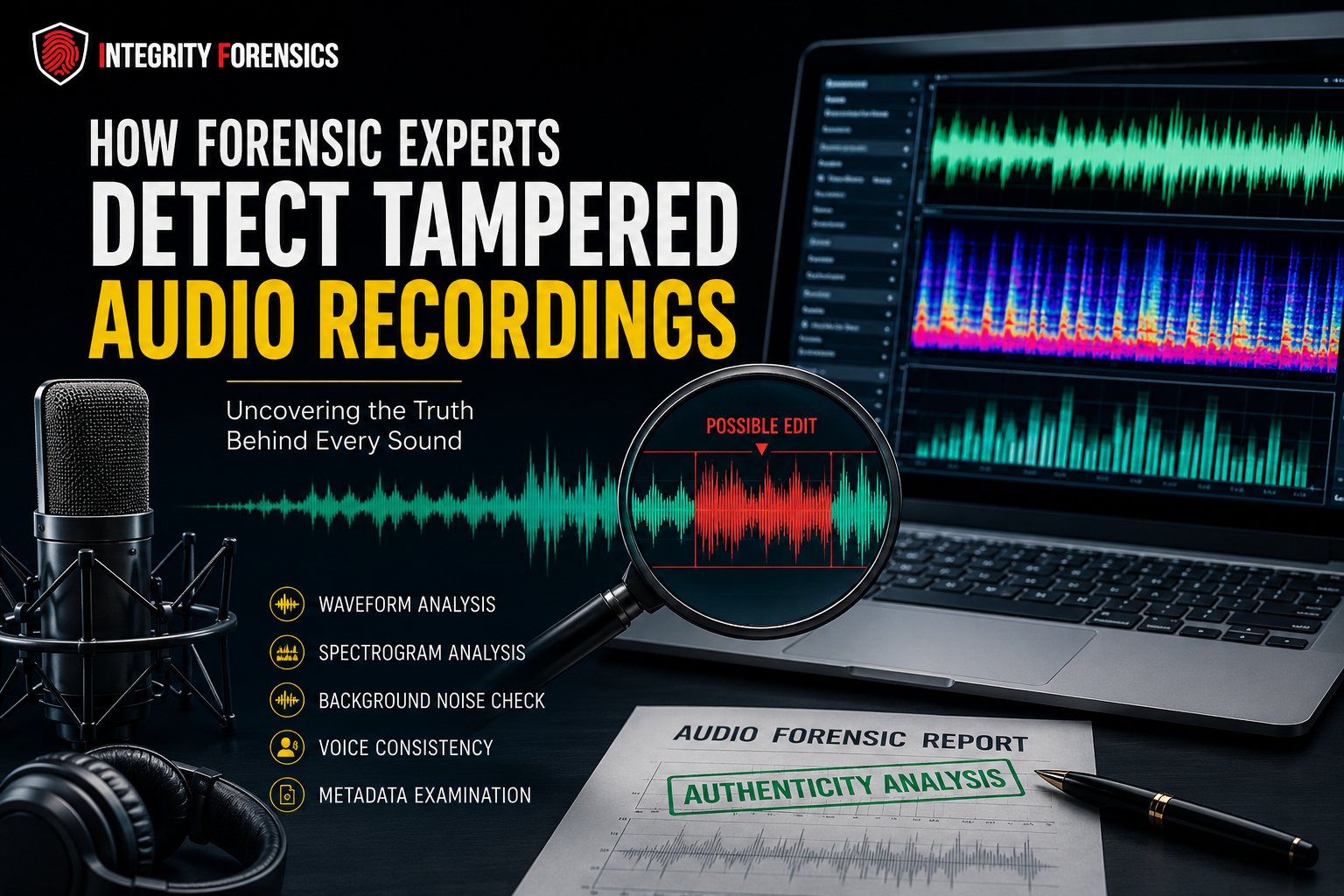
How Forensic Experts Detect Tampered Audio Recordings
Introduction
In today’s digital world, audio recordings have become an important form of evidence in criminal investigations, civil disputes, corporate fraud cases, and personal conflicts. Voice notes, phone call recordings, meeting recordings, and interviews are frequently presented as evidence. However, with the availability of powerful editing software, altering an audio recording has become easier than ever.
A few seconds of deleted conversation, an inserted sentence, or even a manipulated voice can completely change the meaning of a recording. This is where forensic audio experts play a crucial role. Using scientific techniques and specialized software, they examine recordings to determine whether they are genuine or have been tampered with.
What Is Audio Tampering?
Audio tampering refers to any intentional modification made to an original recording in order to alter its meaning or misrepresent facts.
Common types of audio tampering include:
- Cutting or deleting portions of a conversation
- Inserting new speech or sounds
- Rearranging words or sentences
- Changing playback speed
- Removing background noises
- Artificially enhancing or suppressing voices
- Using AI-generated voices (deepfake audio)
Some edits are obvious, while others are nearly impossible to detect without forensic examination.
Why Audio Authentication Is Important
Authenticating an audio recording helps determine whether it can be trusted as evidence. Courts, law enforcement agencies, organizations, and private individuals rely on forensic experts to verify the integrity of recordings before drawing conclusions.
Audio authentication can help in cases involving:
- Criminal investigations
- Financial fraud
- Workplace disputes
- Property conflicts
- Domestic matters
- Defamation cases
- Corruption investigations
- Corporate compliance
A scientifically examined recording provides greater confidence in legal and investigative proceedings.
How Forensic Experts Detect Audio Tampering
1. Listening Examination
The first step is careful listening.
Experts repeatedly listen to the recording using professional audio equipment to identify unusual features such as:
- Sudden pauses
- Abrupt changes in voice quality
- Missing words
- Inconsistent background sounds
- Clicks or pops
- Unexpected silence
Although listening alone cannot prove tampering, it helps identify areas that require deeper analysis.
2. Waveform Analysis
Every audio recording has a waveform representing sound intensity over time.
Forensic experts examine the waveform for irregularities such as:
- Abrupt cuts
- Missing segments
- Unnatural transitions
- Inconsistent amplitude
- Repeated sound patterns
These anomalies may indicate that sections have been edited or removed.
3. Spectrogram Analysis
A spectrogram provides a visual representation of audio frequencies over time.
It helps experts identify:
- Frequency discontinuities
- Artificial insertions
- Edited speech
- Background inconsistencies
- Hidden noises
- Compression artifacts
Spectrogram analysis is one of the most reliable methods for identifying digital editing.
4. Background Noise Examination
Every recording naturally contains ambient sounds, such as:
- Fan noise
- Air conditioning
- Traffic
- Wind
- Electrical hum
- Room reverberation
If these background sounds suddenly disappear or change unexpectedly, it may indicate that portions of the recording have been edited.
For example, if a ceiling fan is audible throughout the recording but disappears for several seconds before returning, it may suggest that a segment was inserted or deleted.
5. Metadata Analysis
Digital recordings contain metadata, including:
- Recording date
- Time
- Device information
- File format
- Software used
- Modification history (where available)
Experts compare this information with the case details to identify inconsistencies.
For instance, if a recording claimed to have been captured on a mobile phone shows evidence of editing software, further investigation may be warranted.
6. Compression Artifact Examination
Every time an audio file is edited and re-saved, compression artifacts may be introduced.
Experts analyze:
- Encoding inconsistencies
- Multiple compression signatures
- Bitrate variations
- Codec mismatches
These technical clues may reveal that the file has undergone editing after its original creation.
7. Voice Consistency Analysis
Forensic experts also examine the speaker’s voice characteristics, including:
- Pitch
- Speaking rate
- Pronunciation
- Intonation
- Breathing patterns
- Natural pauses
Significant inconsistencies may indicate that speech has been inserted, replaced, or generated artificially.
8. Detection of AI-Generated Voices
With advances in artificial intelligence, deepfake audio has become increasingly sophisticated.
Experts look for indicators such as:
- Unnatural speech rhythm
- Robotic transitions
- Repeated acoustic patterns
- Missing breathing sounds
- Synthetic frequency signatures
- Inconsistent emotional expression
Specialized forensic tools can help identify characteristics commonly associated with AI-generated voices.
Common Signs of Audio Manipulation
Although not all are conclusive on their own, experts look for:
- Sudden silence
- Abrupt changes in background noise
- Missing words or incomplete sentences
- Inconsistent volume levels
- Different recording quality within the same file
- Unnatural pauses
- Repeated sounds
- Echo inconsistencies
- Frequency disruptions
- Metadata anomalies
A combination of these indicators strengthens the assessment.
Challenges in Audio Forensic Analysis
Modern editing software can make alterations extremely difficult to detect. Factors such as poor recording quality, background noise, multiple file conversions, or low-bitrate compression can further complicate the examination.
Additionally, the increasing realism of AI-generated voices presents new challenges, requiring experts to continually update their techniques and tools.
The Importance of Maintaining Original Recordings
The original recording is always the most valuable source of evidence.
Experts recommend:
- Preserving the original file without modification.
- Avoid editing or converting the recording.
- Keep the original recording device whenever possible.
- Store backup copies securely.
- Document when, where, and how the recording was obtained.
Proper preservation helps ensure the integrity and admissibility of the evidence.
Why Professional Audio Forensic Examination Matters
Determining whether an audio recording has been tampered with requires specialized knowledge, validated methodologies, and careful analysis. While consumer software may detect obvious edits, only a comprehensive forensic examination can provide an objective, scientifically supported opinion suitable for legal or investigative purposes.
Professional forensic experts use advanced analytical techniques, maintain proper documentation, and prepare reports that can assist investigators, legal professionals, and courts in evaluating the authenticity of digital audio evidence.
Conclusion
As digital audio becomes increasingly common in legal, corporate, and personal disputes, ensuring its authenticity is more important than ever. From waveform and spectrogram analysis to metadata examination and AI voice detection, forensic experts employ a range of scientific methods to assess whether a recording has been altered.
If there is any doubt about the integrity of an audio recording, a professional forensic examination can provide clarity through objective analysis and well-documented findings. In legal matters, the authenticity of a recording can significantly influence the outcome of a case, making forensic audio analysis an essential component of modern investigations.

