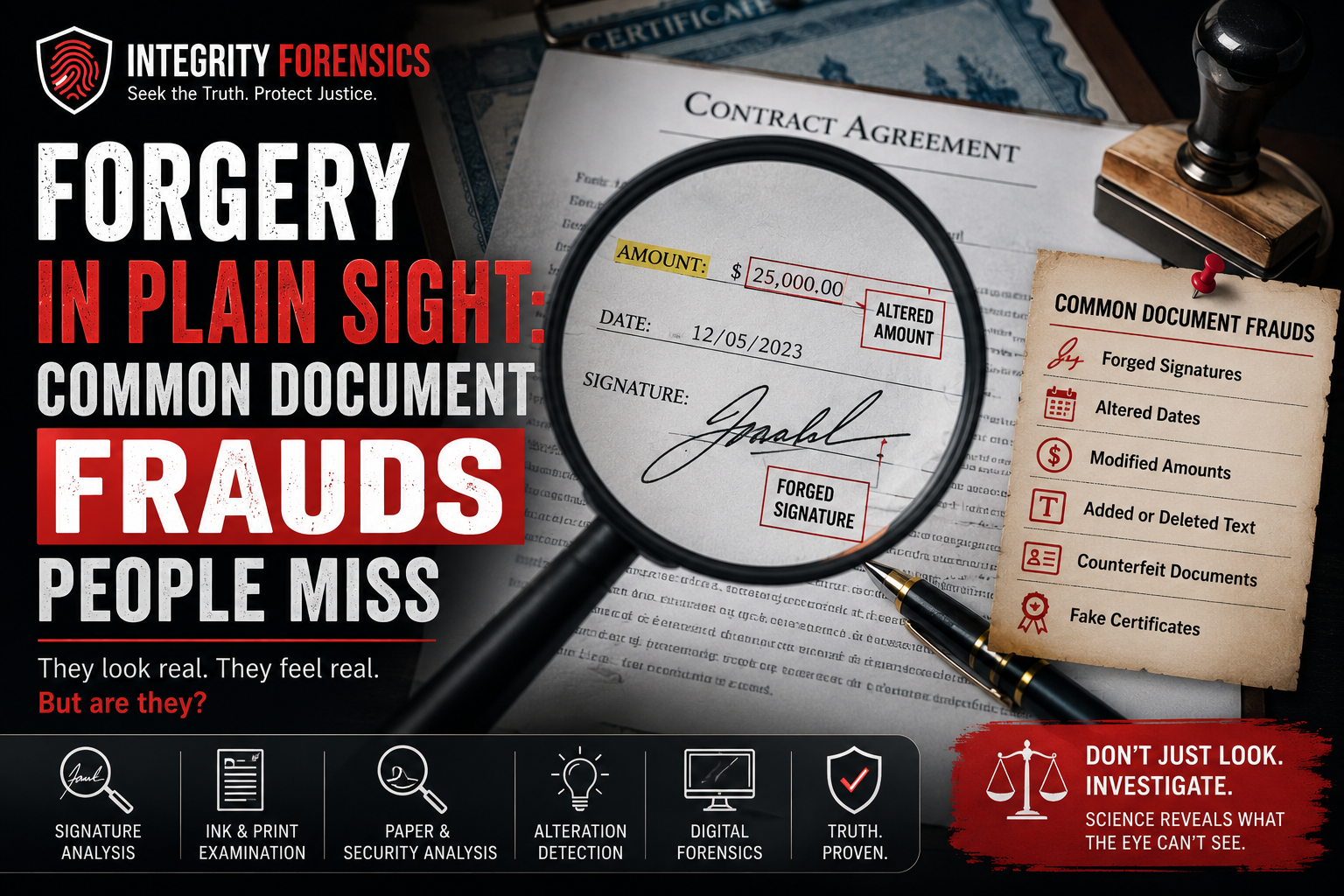
Forgery in Plain Sight: Common Document Frauds People Miss
Introduction
Documents play a crucial role in almost every aspect of modern life. From property agreements and financial transactions to employment records and legal contracts, documents serve as evidence of identity, ownership, consent, and obligation. Because of their importance, documents are often trusted without question. Most people assume that if a document appears genuine, it must be authentic.
Unfortunately, appearances can be deceptive.
Document fraud is one of the most widespread yet overlooked forms of fraud worldwide. Advances in printing technology, scanning devices, image-editing software, and digital document creation tools have made it easier than ever to alter, fabricate, or manipulate documents. Many fraudulent documents appear so convincing that they go unnoticed until a dispute arises or an investigation begins.
Whether it involves forged signatures, altered contracts, manipulated financial records, fake certificates, or counterfeit identity documents, document fraud can result in substantial financial losses, legal complications, reputational damage, and even wrongful convictions.
Forensic document examination plays a critical role in uncovering these hidden manipulations. By applying scientific methods and specialized examination techniques, forensic experts identify signs of fraud that may be invisible to the untrained eye.
This article explores common types of document fraud, how they occur, why they are often overlooked, and how forensic document examination helps reveal the truth hidden within seemingly authentic documents.
What Is Document Fraud?
Document fraud refers to the intentional creation, alteration, modification, or use of a document for deceptive or unlawful purposes.
The objective may be to:
- Obtain financial gain
- Conceal information
- Misrepresent facts
- Avoid legal obligations
- Establish false identity
- Manipulate evidence
Document fraud can occur in both physical and digital formats and affects individuals, businesses, financial institutions, and government agencies alike.
Why Document Fraud Often Goes Undetected
Many fraudulent documents escape detection because people tend to focus on the content rather than the document itself.
A forged document may appear legitimate because:
- The formatting looks professional
- Signatures appear authentic
- Official seals are replicated convincingly
- Alterations are subtle
- Digital modifications leave no obvious visual clues
Without specialized forensic examination, even experienced professionals may overlook signs of tampering.
This is why document fraud is often described as “forgery in plain sight.”
Common Types of Document Fraud
Signature Forgery
One of the most frequently encountered forms of document fraud involves forged signatures.
Fraudsters may attempt to:
- Imitate a genuine signature
- Trace an original signature
- Copy a signature from another document
- Create a fabricated signature altogether
Commonly affected documents include:
- Contracts
- Cheques
- Property agreements
- Loan applications
- Wills and testaments
Although a forged signature may initially appear convincing, forensic examination often reveals differences in line quality, stroke formation, rhythm, pressure patterns, and individual writing characteristics.
Alteration of Existing Documents
In some cases, fraudsters do not create entirely fake documents but instead alter genuine ones.
Examples include:
- Changing dates
- Modifying monetary amounts
- Adding names
- Removing clauses
- Altering terms and conditions
These modifications may seem insignificant but can dramatically change the meaning and legal effect of a document.
Forensic experts often identify such alterations through ink examination, indentation analysis, microscopic inspection, and digital imaging techniques.
Counterfeit Identity Documents
Identity-related fraud has become increasingly common.
Counterfeit documents may include:
- Passports
- Driver’s licenses
- National identity cards
- Educational certificates
- Professional licenses
Fraudsters use these documents to obtain employment, financial benefits, travel privileges, or access to restricted services.
Modern forensic examination evaluates security features, printing techniques, paper characteristics, and embedded identifiers to detect counterfeit documents.
Fraudulent Educational Certificates
Fake educational qualifications remain a significant concern for employers and institutions.
Fraudulent documents may involve:
- Completely fabricated certificates
- Altered academic records
- Modified grades
- Fake university credentials
Verification through forensic examination and institutional authentication is often necessary to establish authenticity.
Forged Financial Documents
Financial fraud frequently involves manipulated documents such as:
- Bank statements
- Income records
- Tax documents
- Audit reports
- Financial disclosures
Even small alterations can influence loan approvals, insurance claims, business transactions, and legal proceedings.
Forensic document examiners identify inconsistencies through detailed analysis of document structure, printing methods, and digital metadata.
Fake Wills and Testamentary Documents
Inheritance disputes often involve allegations of forged or altered wills.
Common concerns include:
- Forged signatures
- Added pages
- Altered beneficiary information
- Modified dates
Because significant assets may be involved, forensic document examination often becomes essential in determining authenticity.
Warning Signs of Document Fraud
Although forensic analysis is often required for confirmation, certain indicators may suggest potential fraud.
Inconsistent Signatures
Differences in:
- Stroke formation
- Slant
- Letter construction
- Writing rhythm
may indicate forgery.
Unusual Corrections
Excessive corrections, overwriting, or erasures can suggest document alteration.
Mismatched Fonts
In digital documents, inconsistent fonts, spacing, or formatting may indicate unauthorized modifications.
Suspicious Dates
Discrepancies between dates and document content can raise concerns regarding authenticity.
Irregular Printing Patterns
Differences in ink density, print quality, or alignment may indicate that portions of a document were added later.
Missing Security Features
Official documents often contain security elements that may be absent or poorly replicated in counterfeit versions.
How Forensic Experts Detect Document Fraud
Forensic document examination combines scientific analysis with specialized expertise.
Handwriting and Signature Examination
Experts compare questioned writing with known samples to determine:
- Authorship
- Authenticity
- Signs of simulation
- Evidence of tracing
Ink Examination
Different inks may reveal whether additions or alterations occurred at different times.
Techniques may include:
- Microscopic analysis
- Spectral examination
- Chemical evaluation
Paper Examination
Paper characteristics often provide important clues regarding authenticity.
Experts assess:
- Thickness
- Texture
- Watermarks
- Fiber composition
- Manufacturing characteristics
Indentation Analysis
Writing pressure may leave impressions on underlying pages.
Specialized equipment can reveal:
- Previous writings
- Hidden entries
- Altered information
Digital Document Examination
Electronic documents are examined for:
- Metadata inconsistencies
- Editing history
- File modifications
- Digital alterations
This is particularly important in modern fraud investigations involving electronic records.
Real-World Consequences of Document Fraud
Document fraud can have serious implications.
Financial Losses
Fraudulent documents may result in:
- Unauthorized transactions
- Loan fraud
- Insurance fraud
- Asset misappropriation
Legal Disputes
Forgery frequently leads to lengthy and costly litigation.
Reputational Damage
Organizations associated with fraudulent documentation may suffer significant reputational harm.
Criminal Liability
Document forgery is a criminal offense in many jurisdictions and may result in fines, imprisonment, or both.
The Role of Forensic Document Examination in Court
When document authenticity is disputed, courts often rely on forensic experts.
Forensic document examiners assist by:
- Conducting scientific examinations
- Identifying alterations
- Detecting forgery
- Preparing expert reports
- Providing courtroom testimony
Their findings help judges and legal professionals evaluate the reliability of documentary evidence.
Preventing Document Fraud
Individuals and organizations can reduce risk by:
- Verifying signatures
- Maintaining document security
- Using secure storage systems
- Implementing document authentication procedures
- Conducting periodic audits
- Preserving original documents
- Seeking forensic examination when authenticity is questioned
Early detection can prevent significant financial and legal consequences.
The Future of Document Fraud Detection
As document fraud techniques evolve, forensic science continues to develop more sophisticated methods of detection.
Emerging technologies include:
- Artificial intelligence-assisted analysis
- Digital authentication systems
- Advanced imaging technologies
- Machine learning-based fraud detection
- Blockchain-based document verification
These innovations will strengthen the ability of forensic experts to identify increasingly sophisticated forms of forgery.
Conclusion
Document fraud often hides in plain sight. A forged signature, altered date, modified clause, or counterfeit certificate may appear perfectly legitimate to an untrained observer while concealing significant deception. As fraud techniques become increasingly sophisticated, relying solely on visual inspection is no longer sufficient.
Forensic document examination provides the scientific tools necessary to uncover hidden alterations, identify forged signatures, authenticate documents, and reveal the truth behind disputed records. Through handwriting analysis, ink examination, paper analysis, indentation studies, and digital forensic techniques, experts help individuals, organizations, and courts distinguish genuine documents from fraudulent ones.
In a world where trust frequently depends on written evidence, forensic document examination remains an essential safeguard against deception, ensuring that authenticity prevails over fraud.

