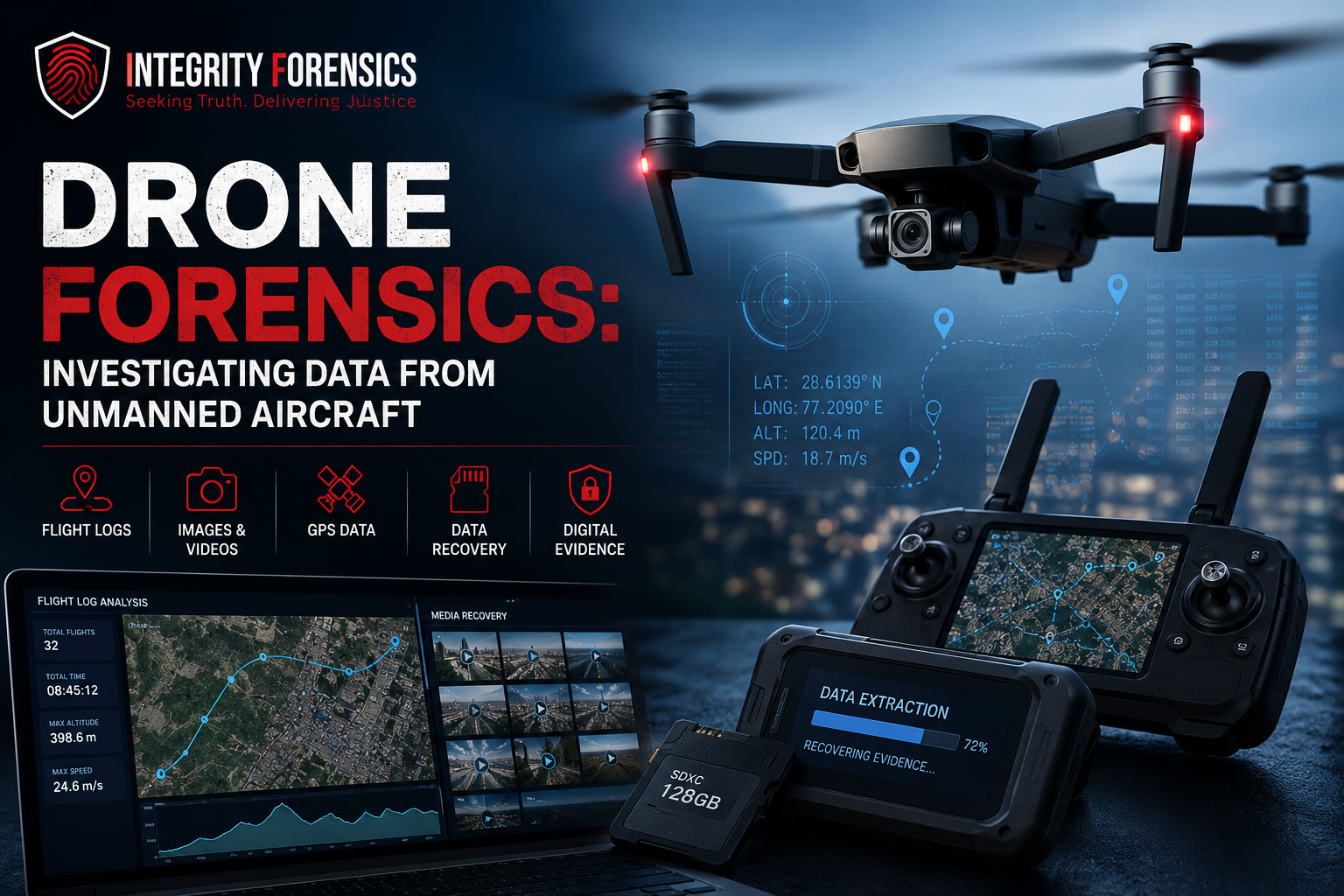
Drone Forensics: Investigating Data from Unmanned Aircraft in Modern Investigations
Introduction
Drones, also known as Unmanned Aerial Vehicles (UAVs), have become increasingly popular across industries ranging from photography and agriculture to construction, security, and logistics. While these devices offer numerous benefits, they are also becoming involved in criminal activities, accidents, privacy violations, and legal disputes. As a result, drone forensics has emerged as a specialized branch of digital forensics focused on recovering, preserving, and analyzing data stored within drones and their associated devices.
Drone forensics enables investigators to uncover valuable digital evidence that can reveal where a drone flew, who operated it, what it recorded, and whether it was involved in unlawful activities. This information can play a critical role in criminal investigations, civil litigation, insurance claims, and corporate security incidents.
What is Drone Forensics?
Drone forensics is the process of identifying, collecting, preserving, analyzing, and presenting digital evidence obtained from drones, their controllers, mobile applications, and cloud-based systems.
Much like smartphones and computers, modern drones generate large amounts of data during operation. This data can provide investigators with detailed insights into the drone’s activities before, during, and after a particular incident.
The primary objective of drone forensics is to ensure that digital evidence is collected in a forensically sound manner while maintaining its integrity and admissibility in legal proceedings.
Sources of Evidence in Drone Investigations
Drone investigations often involve multiple sources of digital evidence, including:
1. Flight Logs
Flight logs are among the most valuable pieces of evidence in drone investigations. These logs can contain:
- Flight paths
- GPS coordinates
- Altitude records
- Speed information
- Battery status
- Flight duration
- Takeoff and landing locations
These records help investigators reconstruct the drone’s movements and activities.
2. Onboard Storage
Many drones contain internal memory or removable storage devices such as SD cards. These storage media may contain:
- Photographs
- Videos
- Audio recordings
- Screenshots
- Telemetry data
Such files can provide direct evidence of a drone’s operations and activities.
3. Remote Controllers
Drone controllers often store operational data, connection records, and device identifiers that can assist investigators in linking a drone to its operator.
4. Mobile Applications
Most drones are operated through smartphone or tablet applications. These apps may contain:
- User account information
- Flight history
- Configuration settings
- Cached images and videos
- Synchronization data
Mobile forensic analysis can reveal important information about drone usage.
5. Cloud Services
Many drone manufacturers offer cloud synchronization services that automatically back up flight records and media files. Cloud-based evidence can supplement data recovered from physical devices.
How Drone Forensics Investigations Are Conducted
A drone forensic examination generally follows a structured process.
Evidence Identification
Investigators first identify all devices associated with the drone ecosystem, including:
- The drone itself
- Remote controller
- Mobile devices
- Memory cards
- Cloud accounts
Evidence Preservation
To maintain evidence integrity, investigators create forensic copies of storage media and carefully document the chain of custody.
Data Extraction
Specialized forensic tools are used to recover data from the drone and related devices. Even deleted information may sometimes be recoverable.
Data Analysis
The extracted information is analyzed to reconstruct events, identify operators, determine flight paths, and uncover any evidence relevant to the investigation.
Reporting
Investigators prepare detailed forensic reports documenting their findings and methodologies, which may later be presented in court.
Applications of Drone Forensics
Drone forensics is increasingly being used across various investigative scenarios.
Criminal Investigations
Drones have been linked to activities such as:
- Smuggling
- Illegal surveillance
- Drug trafficking
- Contraband delivery
- Trespassing
- Unauthorized photography
Forensic analysis can help establish the drone’s involvement and identify responsible individuals.
Accident Investigations
When drone crashes occur, investigators can analyze flight logs and telemetry data to determine whether the incident resulted from:
- Equipment failure
- Pilot error
- Environmental conditions
- Software malfunction
Corporate Security Investigations
Organizations may encounter drones conducting unauthorized surveillance or intellectual property theft. Drone forensic evidence can help determine the source and purpose of such activities.
Insurance Claims
Flight records and onboard data can assist insurers in verifying claims involving drone-related accidents or property damage.
Civil Litigation
Drone evidence may be relevant in disputes involving privacy violations, property damage, workplace incidents, or regulatory compliance.
Challenges in Drone Forensics
Despite its growing importance, drone forensics presents several challenges.
Rapidly Evolving Technology
Drone manufacturers frequently introduce new hardware and software features, requiring forensic specialists to continually update their methodologies.
Data Encryption
Some drones encrypt flight records and stored data, making evidence extraction more complex.
Data Volatility
Certain drone data may be overwritten or lost if devices are powered on or improperly handled after an incident.
Multiple Data Sources
Investigators often need to correlate evidence from drones, mobile devices, cloud accounts, and controllers to obtain a complete picture.
Best Practices for Preserving Drone Evidence
When dealing with potential drone evidence:
- Avoid powering on the device unnecessarily.
- Preserve the drone in its current condition.
- Secure associated controllers and mobile devices.
- Document the scene thoroughly.
- Maintain a clear chain of custody.
- Engage qualified forensic experts as early as possible.
Proper evidence handling significantly increases the likelihood of successful forensic analysis.
The Future of Drone Forensics
As drone technology continues to advance, forensic investigators will face increasingly sophisticated challenges. Emerging technologies such as autonomous flight systems, artificial intelligence, swarm drones, and cloud-integrated operations will generate even larger volumes of digital evidence.
At the same time, advances in forensic tools and investigative techniques will enhance the ability of experts to recover and analyze drone-related data. Drone forensics is expected to become an essential component of modern digital investigations as the use of unmanned aircraft continues to expand worldwide.
Conclusion
Drones are no longer just recreational gadgets; they are powerful digital devices capable of generating substantial amounts of evidentiary data. Through drone forensics, investigators can recover flight logs, GPS records, images, videos, and other critical information that helps reconstruct events and establish facts.
Whether supporting criminal investigations, accident reconstruction, corporate security inquiries, or civil litigation, drone forensics provides valuable insights that can make the difference between unanswered questions and actionable evidence. As drone adoption continues to grow, the importance of professional drone forensic analysis will only become more significant in the world of digital investigations.

