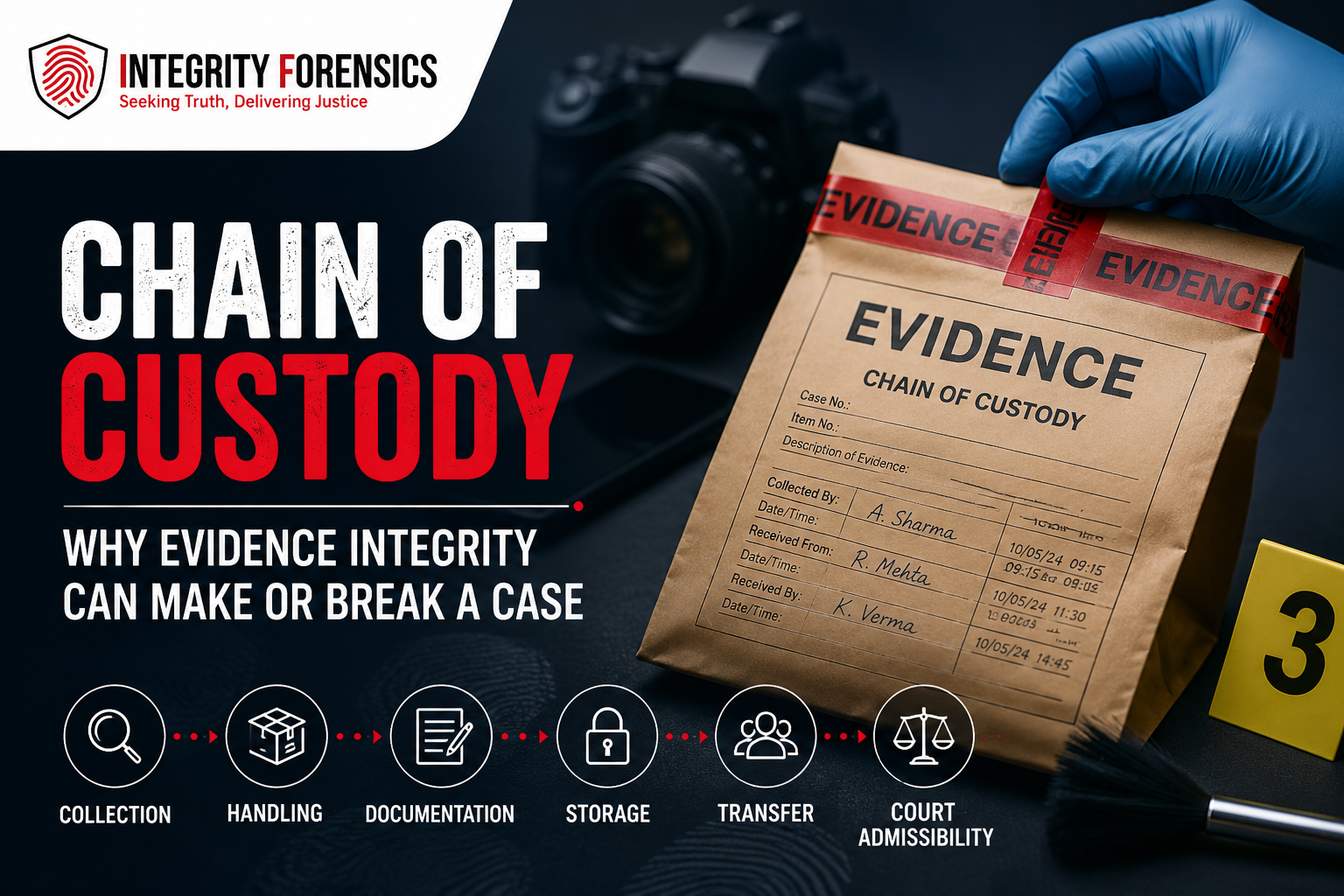
Chain of Custody: Why Evidence Integrity Can Make or Break a Case
Introduction
In any forensic investigation, evidence serves as the foundation upon which facts are established and conclusions are drawn. Whether it is a digital device, a questioned document, biological material, or surveillance footage, the value of evidence depends not only on what it reveals but also on how it has been handled throughout the investigation.
This is where the concept of chain of custody becomes critical. A properly maintained chain of custody ensures that evidence remains authentic, untampered, and legally admissible. Even the strongest piece of evidence can lose its credibility if there is uncertainty about who handled it, where it was stored, or whether it was altered during the investigation process.
For forensic experts, maintaining evidence integrity is not merely a procedural requirement—it is an essential component of ensuring justice.
What Is Chain of Custody?
Chain of custody refers to the documented process that records the collection, handling, transfer, storage, and analysis of evidence from the moment it is obtained until it is presented in court or other legal proceedings.
The purpose of this documentation is to establish a clear and traceable record showing:
- Who collected the evidence
- When and where it was collected
- Who handled or transferred it
- How it was stored
- When it was analyzed
- Where it is currently located
By maintaining a complete record, investigators can demonstrate that the evidence presented is the same evidence originally collected and that it has not been altered or contaminated.
Why Evidence Integrity Matters
Evidence integrity refers to the preservation of the original condition, authenticity, and reliability of evidence throughout an investigation.
When evidence integrity is compromised, several issues may arise:
- Questions regarding authenticity
- Allegations of tampering or contamination
- Challenges to forensic findings
- Rejection of evidence in court
- Reduced credibility of investigators and experts
In legal proceedings, even minor discrepancies in evidence handling can create doubt and significantly impact the outcome of a case.
A properly documented chain of custody helps eliminate these concerns by providing transparency and accountability at every stage.
Key Components of an Effective Chain of Custody
Evidence Collection
The chain of custody begins at the point of collection. Investigators must accurately document the location, condition, and circumstances under which evidence was obtained.
Photographs, collection notes, labels, and unique identification numbers help establish the initial record of the evidence.
Proper Packaging and Storage
Evidence must be stored in appropriate containers and secured to prevent damage, contamination, or unauthorized access.
Different types of evidence require specific storage conditions. For example:
- Digital devices require secure storage and forensic imaging procedures.
- Biological samples may require temperature-controlled environments.
- Documents must be protected from physical damage and environmental exposure.
Documentation of Transfers
Every transfer of evidence between individuals or departments must be recorded.
Documentation typically includes:
- Date and time of transfer
- Names of individuals involved
- Purpose of the transfer
- Signatures or authorization records
This creates an uninterrupted trail that can be reviewed and verified whenever necessary.
Secure Evidence Management
Forensic laboratories and investigative agencies use strict evidence management procedures to ensure security and accountability.
Access to evidence is often restricted to authorized personnel, and all interactions with the evidence are logged and documented.
Chain of Custody in Digital Forensics
The importance of chain of custody has become even greater in the digital age.
Digital evidence such as emails, mobile phone data, CCTV footage, cloud records, and computer files can be easily modified if proper forensic procedures are not followed.
Digital forensic experts typically:
- Create forensic copies rather than examining original data.
- Use hashing techniques to verify data integrity.
- Document every stage of acquisition and analysis.
- Maintain detailed logs of evidence access and examination.
These practices help ensure that digital evidence remains reliable and legally defensible.
Common Challenges in Evidence Handling
Despite established procedures, evidence handling can present several challenges.
Some common issues include:
Incomplete Documentation
Missing dates, signatures, or transfer records can create gaps in the chain of custody.
Improper Storage
Inadequate storage conditions may lead to degradation, contamination, or loss of evidence.
Unauthorized Access
Evidence that can be accessed without proper authorization may be challenged during legal proceedings.
Human Error
Mistakes in labeling, packaging, or recordkeeping can affect evidence reliability and raise concerns regarding authenticity.
Implementing standardized procedures and regular training can significantly reduce these risks.
Legal Admissibility of Evidence
Courts require confidence that evidence presented during legal proceedings is authentic and trustworthy.
A well-maintained chain of custody helps establish:
- Authenticity of evidence
- Reliability of forensic findings
- Compliance with investigative protocols
- Legal admissibility of evidence
When chain of custody records are complete and accurate, forensic experts can confidently demonstrate that the evidence has remained secure and unchanged throughout the investigation.
This strengthens the credibility of both the evidence and the conclusions drawn from it.
The Role of Forensic Experts
Forensic professionals play a crucial role in preserving evidence integrity.
Their responsibilities often include:
- Collecting evidence using approved procedures
- Maintaining detailed documentation
- Ensuring secure storage and transportation
- Conducting examinations using validated methods
- Presenting findings supported by documented evidence trails
By following strict forensic protocols, experts help ensure that evidence withstands scrutiny from investigators, legal professionals, and courts.
Conclusion
Chain of custody is far more than an administrative process—it is the foundation of trustworthy forensic investigations. Proper evidence handling, thorough documentation, and secure forensic evidence management help preserve evidence integrity and ensure legal admissibility.
Whether dealing with physical evidence, digital records, or questioned documents, maintaining an unbroken chain of custody protects the credibility of the investigation and supports fair legal outcomes. In forensic science, the value of evidence depends not only on what it reveals but also on the confidence that it has remained authentic from collection to courtroom presentation.
A strong chain of custody ensures that evidence can withstand scrutiny, support reliable conclusions, and ultimately contribute to the pursuit of justice.

