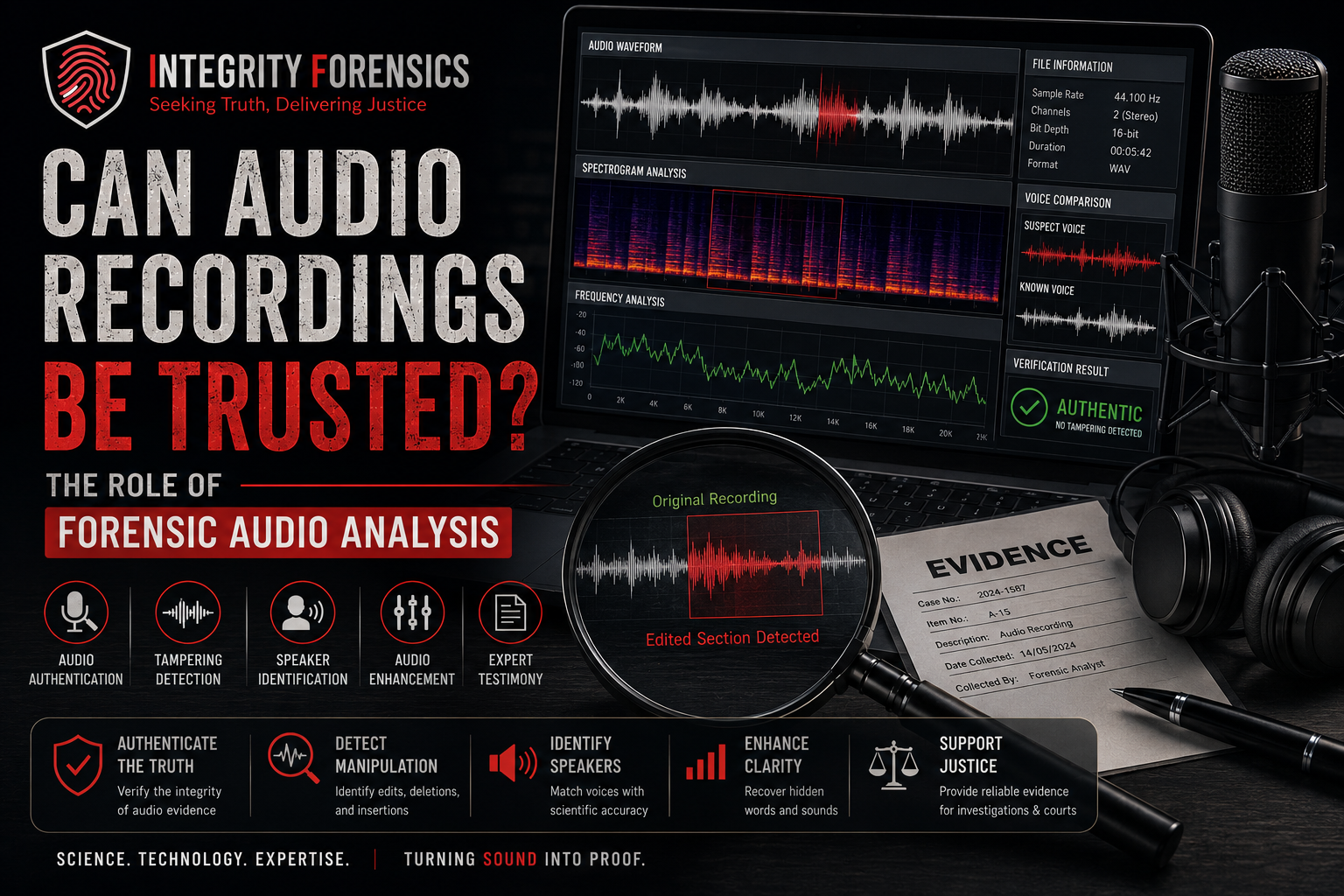
Can Audio Recordings Be Trusted? The Role of Forensic Audio Analysis
Introduction
In today’s digital world, audio recordings have become an increasingly important source of evidence in criminal investigations, civil litigation, corporate disputes, insurance claims, and regulatory proceedings. Conversations captured on mobile phones, voice notes shared through messaging applications, call recordings, surveillance systems, body-worn devices, and digital recorders are frequently presented as evidence to establish facts, verify events, or support allegations.
Many people assume that an audio recording provides a direct and accurate account of what was said. However, advances in audio editing software and digital technology have made it possible to manipulate recordings with remarkable precision. Segments can be deleted, words can be inserted, conversations can be rearranged, and voices can even be artificially generated using artificial intelligence.
As a result, courts, investigators, organizations, and legal professionals can no longer rely solely on listening to a recording when determining its authenticity. Questions often arise regarding whether a recording is original, whether it has been edited, whether the voices belong to the alleged speakers, and whether the recording accurately represents the conversation that took place.
This is where forensic audio analysis becomes essential. By applying scientific examination techniques, specialized software, and expert interpretation, forensic audio analysts help determine the authenticity, integrity, and evidentiary value of audio recordings.
This article explores the science behind forensic audio analysis, the methods used to authenticate recordings, the challenges faced by experts, and the crucial role audio forensics plays in modern investigations and legal proceedings.
Understanding Forensic Audio Analysis
Forensic audio analysis is a specialized branch of forensic science that focuses on the examination, authentication, enhancement, and interpretation of audio recordings for investigative and legal purposes.
The primary objectives of forensic audio analysis include:
- Determining whether a recording is authentic
- Detecting editing or manipulation
- Identifying speakers
- Enhancing poor-quality recordings
- Recovering unintelligible speech
- Verifying recording integrity
- Supporting investigations and legal proceedings
Unlike ordinary listening, forensic audio examination involves a detailed technical analysis of both the audible content and the hidden digital characteristics contained within the recording.
Experts evaluate not only what is heard but also how the recording was created, stored, edited, and transmitted.
Why Audio Evidence Matters
Audio recordings often provide critical information that may not be available through witness statements or documentary evidence.
They are frequently used in:
Criminal Investigations
Audio evidence may assist in:
- Corruption investigations
- Extortion cases
- Threatening communications
- Organized crime investigations
- Terrorism-related inquiries
- Harassment complaints
Civil Litigation
Audio recordings are commonly presented in disputes involving:
- Contractual disagreements
- Employment conflicts
- Family disputes
- Defamation claims
Corporate Investigations
Organizations rely on audio recordings to investigate:
- Employee misconduct
- Internal fraud
- Compliance violations
- Workplace disputes
Insurance and Financial Fraud
Recorded conversations may provide evidence regarding:
- Claim authenticity
- Fraudulent statements
- Financial transactions
Given the significant influence such recordings can have on investigations and legal outcomes, ensuring their authenticity is essential.
Can Audio Recordings Be Manipulated?
The simple answer is yes.
Modern audio editing software allows users to alter recordings in numerous ways without leaving obvious signs detectable by ordinary listeners.
Common forms of audio manipulation include:
- Deletion of words or sentences
- Insertion of new content
- Rearrangement of conversation segments
- Background noise modification
- Voice alteration
- Speed modification
- Artificial voice generation
- Audio splicing
These alterations can dramatically change the meaning and context of a conversation.
As manipulation techniques become increasingly sophisticated, forensic examination has become indispensable for verifying audio evidence.
Common Types of Audio Tampering
Audio Splicing
Splicing occurs when segments from different recordings are combined to create a new recording.
The resulting conversation may appear genuine while actually representing statements made at different times or in different contexts.
Deletion of Content
Specific words, phrases, or entire sections may be removed from a recording.
Such edits can significantly alter the interpretation of a conversation.
Insertion of Content
Additional speech segments may be inserted into a recording to create false evidence or support misleading narratives.
Voice Alteration
Technology can modify voice characteristics such as:
- Pitch
- Tone
- Speed
- Frequency patterns
These modifications may be intended to conceal a speaker’s identity.
AI-Generated Audio
Artificial intelligence can now generate realistic synthetic voices capable of imitating specific individuals.
Such recordings may be used to commit fraud, impersonation, or misinformation.
The Science Behind Audio Authentication
Forensic audio authentication aims to determine whether a recording accurately represents an original event without alteration.
Experts examine various technical and acoustic characteristics to assess authenticity.
The examination process typically includes:
- File analysis
- Metadata examination
- Spectral analysis
- Waveform analysis
- Noise pattern evaluation
- Recording continuity assessment
Each method provides valuable information regarding the integrity of the recording.
Metadata Analysis
Digital audio files contain metadata that provides information about:
- Creation date
- Recording device
- File format
- Software used
- Modification history
Metadata inconsistencies may indicate that a recording has been edited or processed using external software.
For example, a recording allegedly created on a mobile phone may contain metadata showing modification through audio editing software.
Such discrepancies often prompt further forensic examination.
Spectrographic Analysis
One of the most important techniques in forensic audio examination is spectrographic analysis.
A spectrogram is a visual representation of sound frequencies over time.
It allows experts to examine:
- Speech patterns
- Background sounds
- Frequency distributions
- Editing artifacts
- Recording continuity
Spectrograms often reveal manipulations that cannot be detected through listening alone.
Waveform Analysis
Audio recordings can also be examined through waveform analysis.
Waveforms display changes in sound amplitude over time.
Experts analyze waveforms to identify:
- Abrupt transitions
- Unnatural interruptions
- Insertions
- Deletions
- Recording inconsistencies
Waveform examination frequently helps identify tampered sections within recordings.
Background Noise Examination
Every recording environment contains unique acoustic characteristics.
These may include:
- Air conditioning sounds
- Traffic noise
- Electrical hums
- Room reverberation
- Environmental sounds
When audio segments are edited or combined, inconsistencies in background noise often become apparent.
Forensic experts carefully evaluate these characteristics when assessing authenticity.
Speaker Identification
One of the most frequently requested services in forensic audio analysis is speaker identification.
The objective is to determine whether a particular individual is the source of a recorded voice.
Experts compare:
- Vocal characteristics
- Speech patterns
- Pronunciation habits
- Pitch characteristics
- Formant frequencies
- Linguistic features
Speaker identification combines both acoustic analysis and expert interpretation.
Audio Enhancement
Many recordings submitted for examination suffer from poor quality.
Common problems include:
- Background noise
- Low volume
- Distortion
- Echo
- Interference
Forensic audio enhancement involves improving intelligibility while preserving the integrity of the recording.
Enhancement techniques may include:
- Noise reduction
- Frequency filtering
- Signal amplification
- Speech clarification
Enhanced recordings often reveal important information that was previously difficult to understand.
Challenges in Forensic Audio Analysis
Despite technological advancements, forensic audio examination presents several challenges.
Poor Recording Quality
Low-quality recordings may limit the amount of information available for analysis.
Compression Artifacts
Audio shared through messaging applications often undergoes compression, which can affect forensic examination.
Background Noise
Excessive environmental noise can obscure speech and complicate analysis.
Multiple Generations of Copies
Repeated copying may degrade recording quality and remove important forensic indicators.
Sophisticated Editing Tools
Modern editing software continues to evolve, making manipulations increasingly difficult to detect.
AI Voice Cloning
Artificial intelligence can now generate highly realistic synthetic speech, presenting new challenges for forensic experts.
Audio Evidence in Court
Courts frequently consider audio recordings as evidence, but authenticity must be established before such evidence can be relied upon.
Forensic audio experts assist courts by:
- Examining recordings scientifically
- Detecting manipulation
- Identifying speakers
- Enhancing poor-quality recordings
- Preparing forensic reports
- Providing expert testimony
Their findings help judges and legal professionals assess the reliability of audio evidence.
Best Practices for Preserving Audio Evidence
To maximize evidentiary value, individuals and organizations should:
- Preserve original recordings
- Avoid editing files
- Maintain chain of custody
- Document acquisition details
- Create forensic copies
- Store recordings securely
Proper preservation significantly improves the reliability of forensic examinations.
The Future of Forensic Audio Analysis
Technological innovation continues to transform audio forensics.
Emerging developments include:
- Artificial intelligence-based speaker recognition
- Deepfake voice detection
- Automated authenticity assessment
- Advanced signal processing
- Machine learning-assisted analysis
These advancements will help forensic experts address increasingly sophisticated forms of audio manipulation.
However, expert interpretation remains essential because forensic conclusions require scientific judgment beyond automated analysis.
Conclusion
Audio recordings can provide powerful and compelling evidence, but their apparent authenticity should never be assumed. Advances in digital editing technology and artificial intelligence have made it easier than ever to manipulate recordings, alter conversations, and create synthetic voices capable of misleading investigators, organizations, and courts.
Forensic audio analysis serves as a critical safeguard against such deception. Through scientific examination techniques including metadata analysis, spectrographic evaluation, waveform examination, speaker identification, and audio enhancement, forensic experts assess the integrity and authenticity of recordings and help establish their evidentiary value.
In an age where technology can blur the line between reality and fabrication, forensic audio analysis plays a vital role in ensuring that audio evidence remains a reliable tool in the pursuit of truth and justice.

