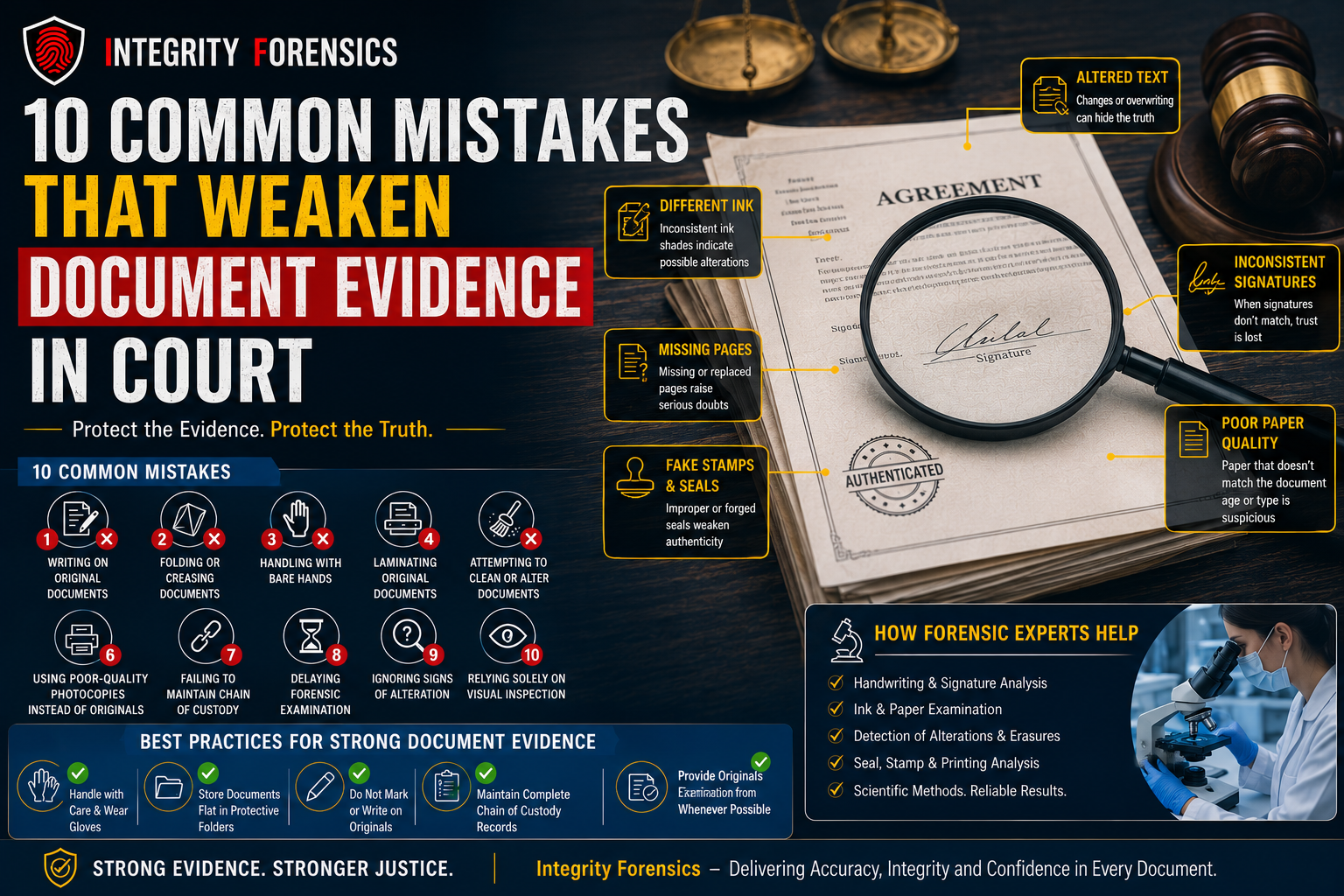
10 Common Mistakes That Weaken Document Evidence in Court
Introduction
Documents often serve as critical evidence in criminal investigations, civil disputes, financial fraud cases, property conflicts, and contractual disagreements. Whether it is a handwritten agreement, a signed contract, a will, a cheque, or a property document, its evidentiary value depends not only on its content but also on its authenticity and integrity.
However, even genuine documents can lose credibility if they are handled improperly or presented without proper verification. Mistakes made during collection, storage, transportation, or examination can compromise the document’s reliability and affect legal proceedings.
Understanding these common errors can help individuals, legal professionals, investigators, and organizations protect valuable documentary evidence and ensure it retains its evidentiary value.
Why Proper Document Handling Matters
Forensic document examination aims to determine whether a document has been altered, forged, fabricated, or genuinely executed. Proper handling preserves important characteristics such as handwriting, signatures, ink, paper quality, impressions, and other physical features that forensic experts rely upon during examination.
Failure to preserve these characteristics may make scientific analysis difficult or even impossible.
1. Writing or Marking Directly on the Original Document
One of the most common mistakes is writing notes, initials, dates, or case numbers directly on the original document.
These markings may:
- Obscure handwriting characteristics
- Damage signatures
- Alter original ink patterns
- Interfere with forensic examination
Instead, identification labels should be placed on protective folders or evidence packaging rather than on the document itself.
2. Folding or Creasing Important Documents
Repeated folding creates permanent creases that may damage:
- Handwriting
- Signatures
- Printed text
- Indented writing
- Ink deposits
Whenever possible, original documents should be stored flat in protective folders or archival sleeves.
3. Handling Documents with Bare Hands
Natural oils, sweat, moisture, and contaminants from hands can affect valuable forensic evidence.
Improper handling may:
- Leave unwanted fingerprints
- Smudge ink
- Damage fragile paper
- Contaminate DNA evidence (where applicable)
Using clean gloves minimizes the risk of contamination.
4. Laminating Original Documents
Lamination permanently seals the document beneath plastic.
Although done to protect documents, lamination can:
- Damage ink
- Prevent examination of paper fibers
- Obscure security features
- Make certain forensic tests impossible
Original legal documents should never be laminated if forensic examination may be required.
5. Attempting to Clean or Restore the Document
People sometimes try to erase stains, remove tape, clean dirt, or flatten damaged documents.
Such attempts can unintentionally:
- Remove ink
- Destroy handwriting
- Alter paper fibers
- Eliminate latent fingerprints
- Damage security features
Document restoration should only be performed by trained professionals.
6. Using Poor-Quality Photocopies Instead of Originals
Photocopies are useful for reference but often lack critical forensic details.
A copy cannot reliably preserve:
- Ink characteristics
- Pen pressure
- Indented writing
- Paper quality
- Security features
- Original impressions
Whenever possible, the original document should be made available for forensic examination.
7. Failing to Maintain Chain of Custody
Chain of custody refers to the documented record of who collected, handled, transported, stored, and examined the evidence.
Poor documentation can create doubts regarding:
- Evidence integrity
- Possible tampering
- Unauthorized access
- Authenticity
Maintaining a clear chain of custody strengthens the credibility of documentary evidence.
8. Delaying Forensic Examination
Waiting too long before seeking forensic analysis can reduce the quality of evidence.
Over time:
- Ink may fade.
- Paper may deteriorate.
- Environmental damage may occur.
- Important records may become unavailable.
Prompt examination helps preserve the maximum amount of forensic information
9. Ignoring Signs of Alteration
Small inconsistencies are sometimes overlooked, including:
- Different ink colours
- Overwriting
- Erasures
- Missing pages
- Cut-and-paste alterations
- Misaligned text
- Different fonts
These seemingly minor details may indicate significant document manipulation.
Whenever doubts arise, professional forensic examination should be considered.
10. Relying Solely on Visual Inspection
Many forged documents appear convincing to the naked eye.
Professional forensic experts use specialized techniques such as:
- Microscopic examination
- Ultraviolet and infrared analysis
- Ink comparison
- Paper examination
- Handwriting analysis
- Digital document analysis
Scientific examination often reveals alterations that ordinary observation cannot detect.
Best Practices for Preserving Document Evidence
To maintain the integrity of documentary evidence:
- Store documents flat in protective folders.
- Handle originals with clean gloves whenever possible.
- Avoid writing on or marking original documents.
- Never laminate evidence that may require forensic examination.
- Preserve original documents instead of relying solely on copies.
- Maintain complete chain of custody records.
- Protect documents from moisture, heat, and sunlight.
- Seek professional forensic examination promptly if authenticity is questioned.
How Forensic Experts Help
Forensic document experts use scientifically accepted methods to examine questioned documents and identify signs of forgery, alteration, or manipulation.
Their examination may include:
- Handwriting and signature comparison
- Ink examination
- Paper analysis
- Stamp and seal verification
- Printing analysis
- Detection of erased or altered entries
- Digital document authentication
The findings are documented in detailed forensic reports that can assist investigators, legal professionals, organizations, and courts.
Conclusion
Documentary evidence can significantly influence the outcome of legal proceedings, but its value depends on careful preservation and proper forensic evaluation. Simple mistakes—such as folding documents, writing on originals, relying only on photocopies, or failing to maintain chain of custody—can weaken otherwise valuable evidence.
By following proper evidence-handling practices and seeking timely forensic examination, individuals and organizations can help ensure that documents remain reliable, credible, and suitable for legal scrutiny. Protecting the integrity of documentary evidence is not only a matter of good practice—it is an essential step toward achieving fair and informed judicial outcomes.

