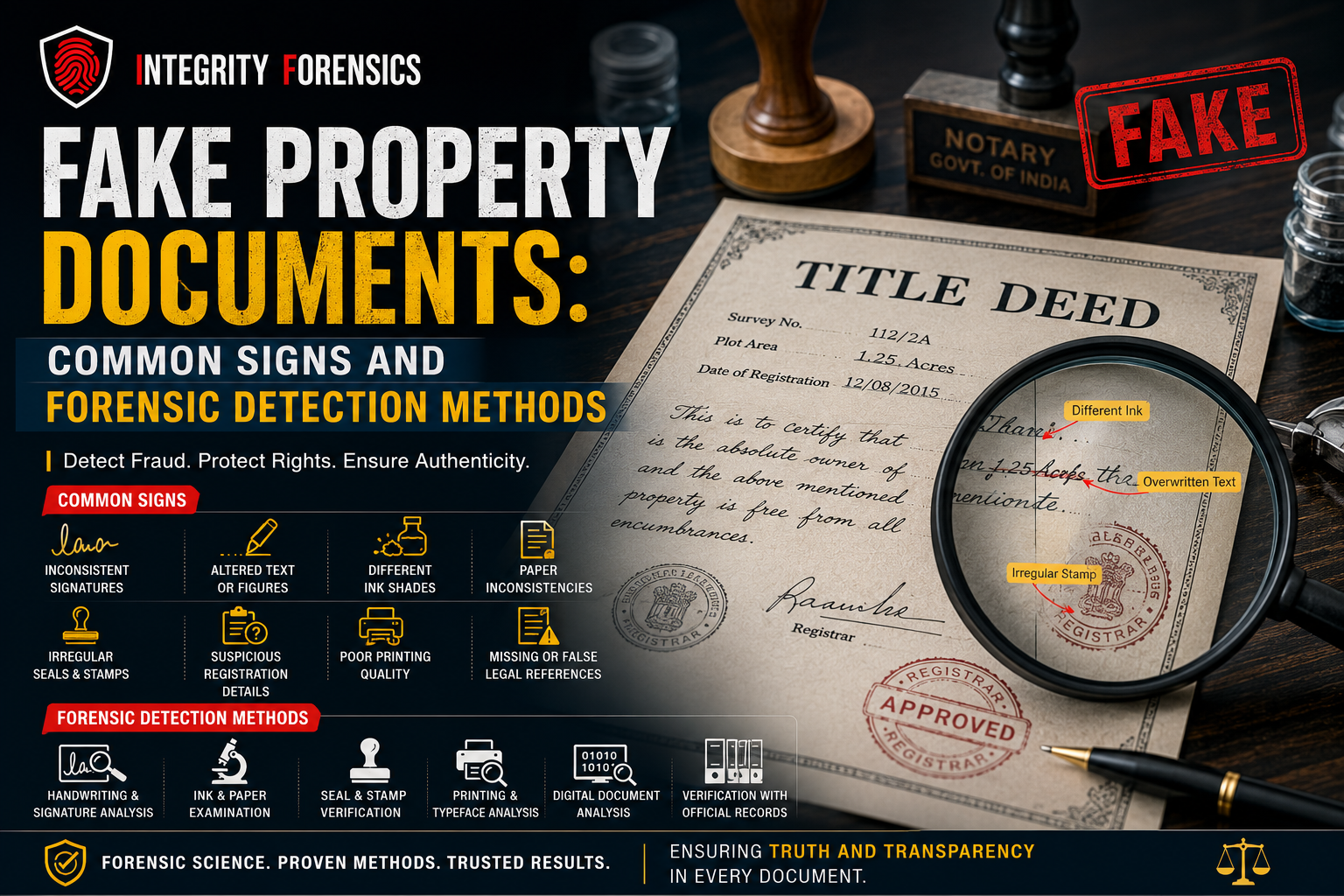
Fake Property Documents: Common Signs and Forensic Detection Methods
Introduction
Property transactions often involve substantial financial investments, making them a common target for fraudsters. Forged sale deeds, altered ownership records, fake agreements, and manipulated land documents can lead to lengthy legal disputes and significant financial losses.
With advances in printing technology and digital editing tools, fraudulent property documents can appear convincing to the untrained eye. However, forensic document examination provides scientific methods to detect alterations, identify forgery, and verify document authenticity.
Understanding the warning signs of fake property documents can help buyers, sellers, legal professionals, and property owners protect themselves from fraud.
What Are Fake Property Documents?
Fake property documents are documents that have been altered, fabricated, or fraudulently created to misrepresent ownership, transfer rights, or conceal important information related to a property.
Examples include:
- Forged sale deeds
- Fake gift deeds
- Altered lease agreements
- Fabricated ownership records
- Manipulated land registry documents
- Forged signatures on property papers
- Fraudulent power of attorney documents
- Tampered property tax records
Common Signs of Fake Property Documents
1. Inconsistent Fonts and Formatting
Fraudsters often create forged documents by combining content from different sources.
Warning signs include:
- Different font styles within the same document
- Uneven spacing
- Misaligned text
- Irregular margins
- Inconsistent paragraph formatting
Such discrepancies may indicate unauthorized alterations.
2. Suspicious Signatures
Signatures are frequently targeted during property fraud.
Indicators of possible forgery include:
- Tremors or shakiness
- Slow pen movements
- Unnatural pen lifts
- Differences from known signatures
- Traced or simulated signatures
A forensic handwriting examination can help determine authenticity.
3. Altered Dates and Numbers
Property fraud often involves changes to:
- Dates of execution
- Property measurements
- Survey numbers
- Registration details
- Consideration amounts
Alterations may be visible as overwriting, erasures, additions, or inconsistencies in handwriting and printing.
4. Differences in Ink
When additions or modifications are made after a document is signed, different inks may be used.
Experts look for:
- Variations in ink color
- Differences in ink flow
- Distinct writing characteristics
Scientific examination may reveal whether entries were made at different times.
5. Irregular Stamps and Seals
Official property documents often contain stamps, seals, and endorsements.
Potential warning signs include:
- Poor-quality impressions
- Distorted seals
- Incorrect wording
- Missing security features
- Unusual placement
Forensic comparison with genuine samples can identify counterfeit stamps.
6. Signs of Digital Manipulation
Modern property fraud frequently involves digital editing.
Indicators may include:
- Pixel inconsistencies
- Altered text layers
- Cloned signatures
- Cut-and-paste modifications
- Metadata anomalies
Digital forensic analysis can help detect these alterations.
How Forensic Experts Detect Property Document Fraud
Handwriting and Signature Examination
Experts compare questioned signatures and handwritten entries with genuine samples to identify similarities and differences in writing habits, letter formations, pen pressure, rhythm, and movement.
Ink Examination
Specialized instruments and lighting techniques may help determine whether different inks were used or whether alterations have been made after document execution.
Microscopic Examination
Magnification can reveal:
- Erasures
- Overwriting
- Retouching
- Pen lifts
- Mechanical alterations
Details invisible to the naked eye often become apparent under forensic examination.
Ultraviolet (UV) and Infrared (IR) Analysis
Different inks and papers react differently under specialized light sources.
These examinations may reveal:
- Hidden alterations
- Erased entries
- Added text
- Chemical changes
Printed Document Examination
Experts analyze:
- Printer characteristics
- Toner distribution
- Printing defects
- Alignment patterns
These features can help determine whether pages originated from the same source or have been substituted.
Digital Forensic Analysis
For electronic property records and scanned documents, forensic experts examine:
- Metadata
- File history
- Editing traces
- Digital manipulation indicators
This can provide valuable information regarding document creation and modification.
Why Early Verification Is Important
Detecting fraud before completing a property transaction can prevent:
- Financial losses
- Ownership disputes
- Litigation costs
- Registration complications
- Criminal investigations
Verification is especially important when dealing with high-value properties or disputed ownership claims.
Tips to Protect Yourself from Property Document Fraud
- Verify ownership records through official authorities.
- Examine original documents whenever possible.
- Cross-check registration details.
- Confirm the authenticity of signatures and witnesses.
- Review power of attorney documents carefully.
- Seek legal and forensic assistance when doubts arise.
- Preserve copies of all transaction records.
The Role of Forensic Document Examination in Legal Cases
Forensic document examination provides an objective scientific assessment of questioned property documents. Expert findings can assist investigators, legal professionals, courts, financial institutions, and property owners in determining whether a document is genuine or has been altered.
When properly conducted, forensic examination can uncover critical evidence that may otherwise go unnoticed.
Conclusion
Property document fraud remains a significant concern in real estate transactions. Forged signatures, altered dates, counterfeit seals, and digitally manipulated records can lead to serious legal and financial consequences. Fortunately, forensic document examination offers reliable methods for detecting fraud and verifying authenticity.
By recognizing common warning signs and seeking professional examination when necessary, individuals and organizations can better protect themselves from property-related fraud and ensure that important decisions are based on genuine documentation.

