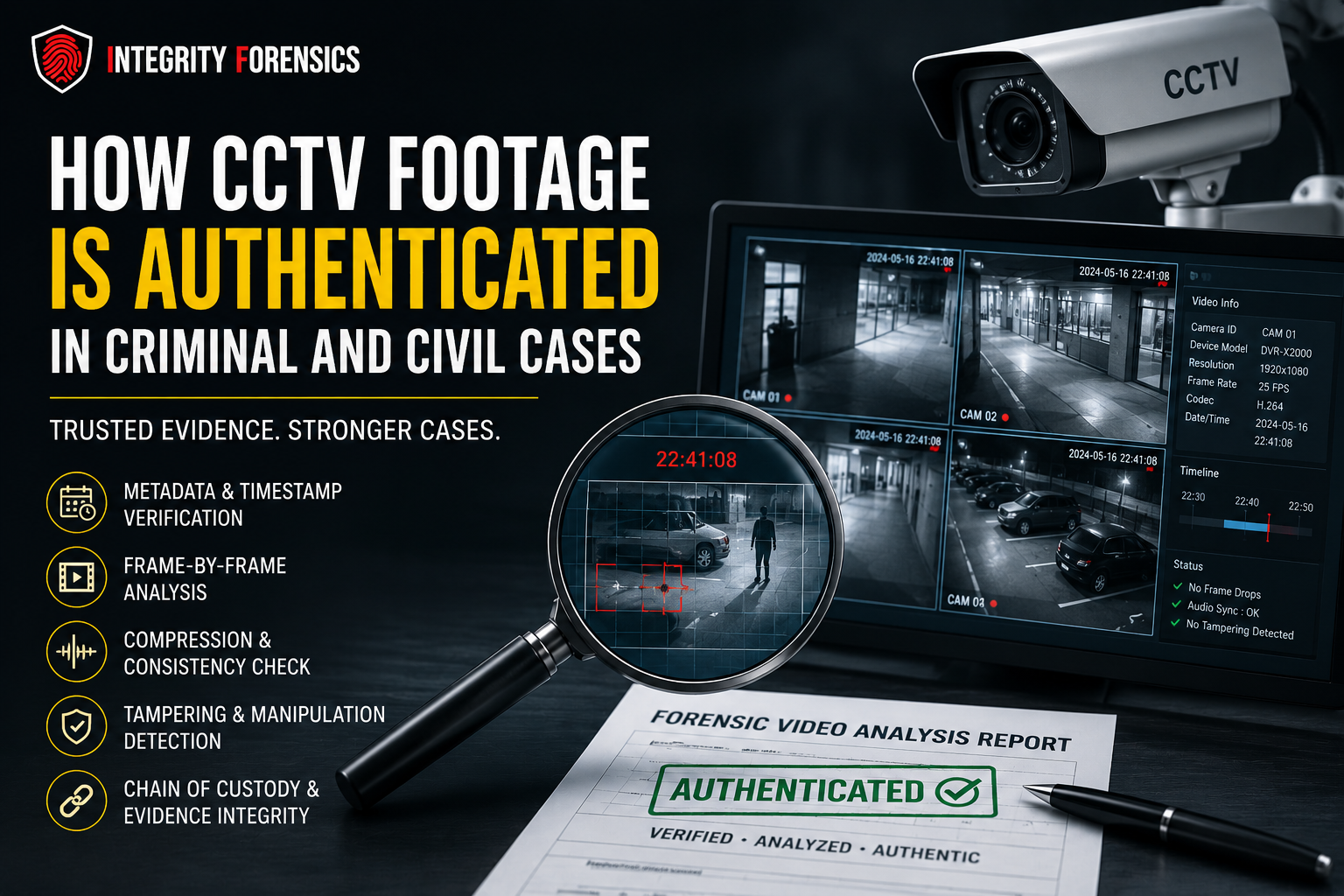
How CCTV Footage Is Authenticated in Criminal and Civil Cases
Introduction
CCTV cameras have become an integral part of modern security systems, capturing events in homes, offices, banks, public places, and commercial establishments. Today, CCTV footage is frequently relied upon as evidence in criminal investigations, insurance claims, workplace disputes, property conflicts, and civil litigation.
However, simply possessing a video recording does not automatically establish its authenticity. With the availability of sophisticated video editing software and artificial intelligence (AI) tools, CCTV footage can potentially be manipulated, raising concerns about its reliability as evidence.
This is where forensic video authentication plays a vital role. Using scientifically accepted methods and specialized software, forensic experts examine CCTV recordings to determine whether they are original, authentic, and free from tampering.
Why CCTV Authentication Is Important
A video recording can significantly influence the outcome of a legal case. Courts and investigating agencies must be confident that the footage accurately represents the events without alteration.
Authentication helps establish:
- Whether the footage is genuine
- Whether it has been edited or manipulated
- Whether the date and time are reliable
- Whether important portions have been deleted
- Whether the recording can be presented as credible evidence
Proper authentication strengthens the evidentiary value of CCTV recordings.
Cases Where CCTV Authentication Is Commonly Required
Forensic examination of CCTV footage is frequently required in:
- Criminal investigations
- Theft and burglary cases
- Road traffic accidents
- Assault and homicide investigations
- Property disputes
- Workplace misconduct investigations
- Insurance fraud cases
- Corporate investigations
- Public safety incidents
Both law enforcement agencies and private individuals may seek authentication depending on the nature of the dispute.
The CCTV Authentication Process
1. Collection of Original Evidence
The first step is obtaining the original recording whenever possible.
Experts prefer:
- Original DVR or NVR devices
- Original hard drives
- Memory cards
- Native exported video files
Working with original evidence reduces the possibility of introducing additional changes during analysis.
2. Preservation of Digital Evidence
Before examination begins, forensic experts create a forensic copy (bit-by-bit image) of the storage media.
This ensures:
- The original evidence remains unchanged.
- Analysis is performed on a duplicate.
- Evidence integrity is maintained throughout the investigation.
Proper preservation is essential for maintaining the chain of custody.
3. Metadata Examination
Every digital video contains metadata that may include:
- Recording date
- Time
- Camera model
- Resolution
- Frame rate
- Codec
- File creation date
- File modification date
Experts compare this information with the facts of the case to identify inconsistencies.
For example, if the metadata indicates that the file was modified after the alleged incident, further examination becomes necessary.
4. Frame-by-Frame Analysis
Rather than simply watching the video, forensic experts examine each frame individually.
This allows them to detect:
- Missing frames
- Inserted frames
- Repeated frames
- Abrupt transitions
- Visual inconsistencies
- Motion irregularities
Even subtle alterations that are invisible during normal playback may become evident during frame-by-frame analysis.
5. Compression Analysis
Digital videos undergo compression to reduce file size.
Forensic experts examine:
- Compression artifacts
- Encoding inconsistencies
- Double compression
- Bitrate variations
If different portions of the same recording exhibit different compression characteristics, it may indicate editing.
6. Timestamp Verification
Many CCTV recordings display timestamps directly on the video.
Experts verify whether:
- The timestamp is continuous.
- Time progresses naturally.
- Any time segments are missing.
- The timestamp matches system metadata.
Incorrect or inconsistent timestamps may suggest device misconfiguration or possible manipulation.
7. Image Consistency Examination
Experts carefully examine the visual characteristics of the recording, including:
- Lighting conditions
- Shadows
- Camera angles
- Object movement
- Reflections
- Image sharpness
- Noise patterns
Sudden changes without a logical explanation may indicate editing.
8. Detection of Video Tampering
Forensic experts look for common indicators of manipulation, including:
- Cropped footage
- Deleted segments
- Frame insertion
- Object removal
- Artificial blurring
- Speed manipulation
- AI-generated content
- Deepfake techniques
Advanced software helps identify subtle traces left behind during editing.
9. Audio-Video Synchronization
If the CCTV recording contains audio, experts verify whether the sound matches the visual events.
They examine:
- Lip synchronization
- Ambient sounds
- Timing consistency
- Voice continuity
Synchronization issues may indicate that either the audio or video has been altered.
10. Preparation of a Forensic Report
After completing the examination, the forensic expert prepares a detailed report documenting:
- The evidence examined
- Scientific methods used
- Observations
- Findings
- Limitations (if any)
- Conclusion regarding authenticity
This report may be used by investigators, legal professionals, insurance companies, or presented before a court.
Common Signs of CCTV Tampering
While not every anomaly indicates manipulation, forensic experts commonly look for:
- Missing video segments
- Abrupt scene changes
- Duplicate frames
- Pixel inconsistencies
- Different compression levels
- Irregular timestamps
- Audio-video mismatch
- Sudden changes in brightness
- AI-generated visual artifacts
- Metadata inconsistencies
These indicators are evaluated collectively rather than in isolation.
Challenges in CCTV Authentication
Authenticating CCTV footage can be complex due to several factors:
- Low-resolution recordings
- Poor lighting conditions
- Weather interference
- Overwritten footage
- Multiple video conversions
- Proprietary CCTV file formats
- Damaged storage devices
- AI-enhanced video manipulation
Modern forensic tools help experts address many of these challenges while maintaining scientific rigor.
Best Practices for Preserving CCTV Evidence
To maximize the reliability of CCTV footage:
- Preserve the original recording immediately.
- Avoid editing or converting the video.
- Retain the original DVR/NVR device whenever possible.
- Record details of when and how the footage was obtained.
- Maintain proper chain of custody.
- Store backup copies securely.
Proper evidence handling significantly improves the chances of successful forensic authentication.
The Role of CCTV Authentication in Court
Courts assess not only what a video shows but also whether it can be trusted. A forensic video examination provides an objective, scientific assessment of the recording’s integrity.
An authenticated CCTV recording can:
- Corroborate witness testimony
- Establish timelines
- Identify individuals or vehicles (where image quality permits)
- Support or challenge claims made by parties
- Strengthen the evidentiary value of digital recordings
It is important to note that the admissibility and weight of CCTV evidence ultimately depend on the applicable laws and the court’s assessment of the evidence.
Why Professional Forensic Examination Matters
Video editing software has become increasingly sophisticated, making manipulations difficult to detect with the naked eye. Professional forensic experts use validated methodologies, specialized software, and technical expertise to examine CCTV footage for signs of alteration.
Their findings provide investigators and legal professionals with scientifically supported conclusions regarding the authenticity and integrity of the recording.
Conclusion
CCTV footage has become one of the most influential forms of digital evidence in both criminal and civil proceedings. However, its value depends on its authenticity. Through metadata examination, frame-by-frame analysis, compression analysis, timestamp verification, and other forensic techniques, experts can determine whether a recording has been altered or remains a true representation of events.
When the authenticity of CCTV footage is questioned, a professional forensic examination helps ensure that decisions are based on reliable and scientifically evaluated evidence.

