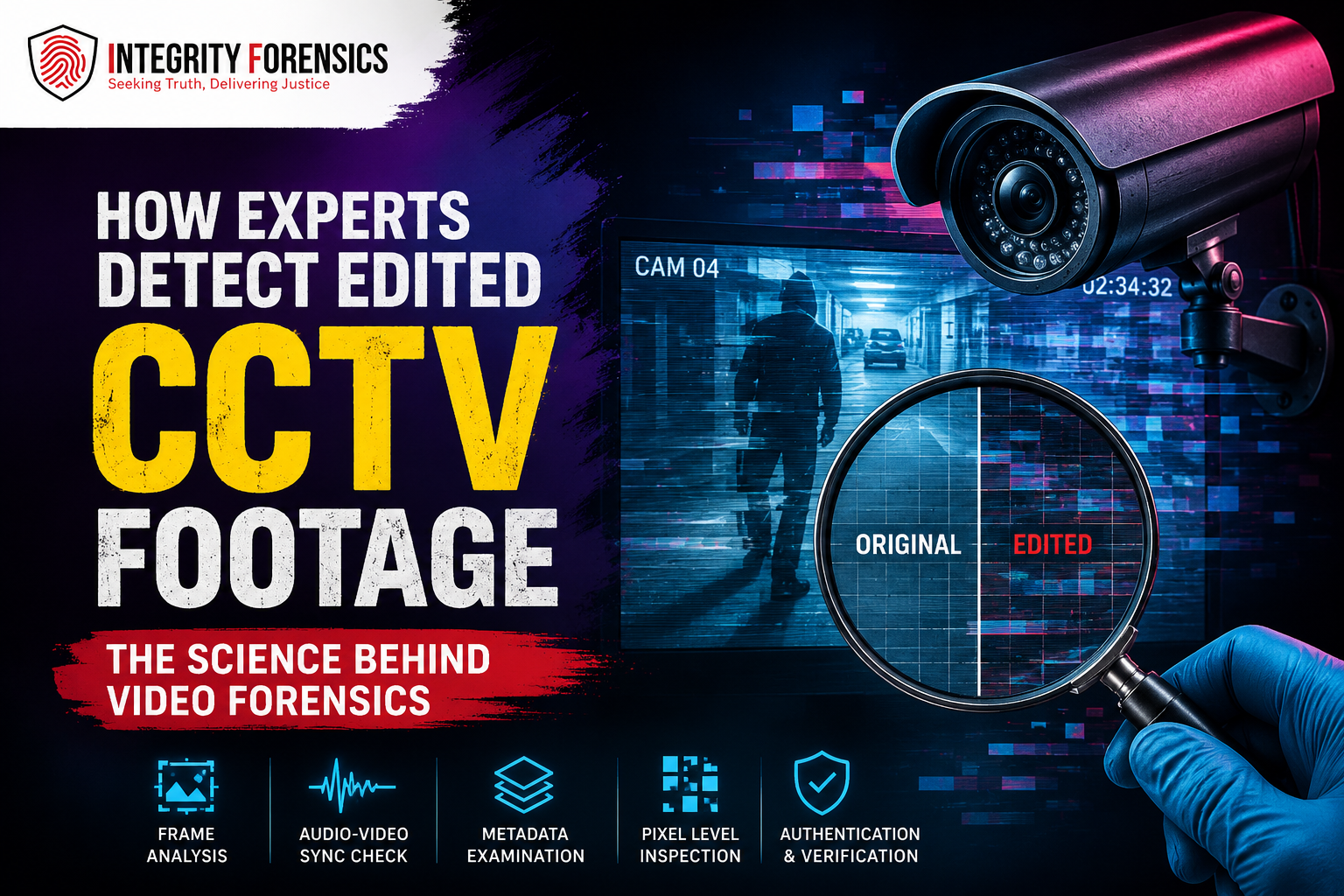
How Experts Detect Edited CCTV Footage: The Science Behind Video Forensics
Introduction
CCTV cameras have become an essential part of modern security systems. From residential buildings and commercial establishments to public spaces and transportation hubs, surveillance cameras continuously record activities that may later serve as critical evidence during investigations.
However, the increasing availability of video editing software has made it easier than ever to alter, manipulate, or fabricate CCTV footage. Edited videos can be used to conceal criminal activity, create false narratives, or mislead investigators and courts.
This is where forensic video analysis plays a crucial role. Forensic experts use specialized tools and scientific techniques to determine whether CCTV footage has been altered and to establish its authenticity. Their findings often become vital evidence in legal proceedings.
Why CCTV Footage Can Be Manipulated
There are several reasons why an individual may attempt to edit surveillance footage:
- To remove evidence of a crime
- To conceal the identity of a suspect
- To alter timelines or events
- To create false evidence
- To support fraudulent claims or disputes
Because CCTV footage is frequently relied upon in investigations, ensuring its authenticity is critical before it can be accepted as reliable evidence.
Common Types of CCTV Footage Manipulation
Before understanding how experts detect tampering, it is important to know the common methods used to alter surveillance videos.
Frame Deletion
Specific frames are removed to hide certain actions or events from the recording.
Frame Insertion
Additional frames are inserted into a video to create misleading sequences or false events.
Object Removal
Advanced editing software can remove people, vehicles, or objects from footage.
Timestamp Manipulation
Date and time information may be altered to create confusion regarding when an incident occurred.
Video Splicing
Multiple video clips are combined to create a modified version of events.
Compression and Re-Encoding
Videos are sometimes repeatedly compressed or re-encoded to hide traces of editing.
How Forensic Experts Detect Edited CCTV Footage
Video forensic specialists employ a combination of scientific examination, digital analysis, and specialized software to identify signs of tampering.
1. Metadata Analysis
Every digital video contains metadata, which includes information about:
- Creation date
- Modification date
- Device details
- Recording format
- Software used for editing
By examining metadata, forensic experts can identify inconsistencies that suggest a video has been altered after recording.
For example, if CCTV footage supposedly came directly from a surveillance system but metadata indicates editing software was used, further investigation becomes necessary.
2. Frame-by-Frame Examination
Experts carefully inspect videos frame by frame to identify irregularities such as:
- Missing frames
- Duplicate frames
- Sudden scene transitions
- Unnatural motion patterns
- Inconsistent object positioning
Even minor alterations often leave visual traces that become apparent during detailed examination.
3. Compression Artifact Analysis
Digital videos contain compression patterns created during recording.
When footage is edited and saved again, additional compression artifacts may appear. Video forensic tools can detect these anomalies and determine whether a file has undergone unauthorized modifications.
4. Error Level Analysis
Different portions of an edited video may exhibit varying levels of compression and image quality.
By analyzing these differences, experts can identify regions where objects, individuals, or backgrounds may have been altered or inserted.
5. Lighting and Shadow Examination
Authentic footage generally maintains consistent lighting conditions throughout a scene.
Forensic analysts examine:
- Shadow directions
- Light intensity
- Reflections
- Environmental lighting consistency
Inconsistencies can indicate that elements have been digitally added or removed.
6. Audio-Video Synchronization Analysis
When CCTV systems record both audio and video, experts examine whether the two remain synchronized.
Tampering may cause:
- Delayed audio
- Missing sound segments
- Unusual synchronization gaps
These discrepancies often provide important clues regarding manipulation.
7. Pixel-Level Analysis
Advanced forensic software allows investigators to examine videos at the pixel level.
This analysis can reveal:
- Cloning effects
- Artificial object removal
- Edited regions
- Reconstructed backgrounds
Pixel-level inconsistencies often remain invisible to the naked eye but can be detected through forensic examination.
8. Source Device Verification
Experts compare the questioned footage with recordings generated directly from the original CCTV system.
This process helps determine whether:
- The file originated from the claimed device
- The recording format is consistent
- Any alterations occurred after extraction
Source verification is often a crucial step in establishing authenticity.
Challenges in CCTV Video Authentication
Detecting tampering is not always straightforward.
Investigators frequently encounter challenges such as:
- Poor video quality
- Low-resolution recordings
- Overwritten footage
- Heavy compression
- Missing original files
- Proprietary CCTV formats
Despite these challenges, modern forensic tools enable experts to uncover many forms of manipulation with a high degree of accuracy.
The Importance of Professional Video Forensics
A manipulated CCTV recording can significantly impact criminal investigations, civil disputes, insurance claims, and corporate inquiries.
Professional forensic analysis helps:
- Verify the authenticity of evidence
- Identify video tampering
- Support legal proceedings
- Protect innocent individuals
- Strengthen investigative findings
Courts and law enforcement agencies often rely on qualified forensic experts to provide objective opinions regarding the integrity of surveillance footage.
Conclusion
CCTV footage is often considered one of the most powerful forms of evidence, but its value depends entirely on its authenticity. With the widespread availability of video editing technology, verifying surveillance recordings has become more important than ever.
Through metadata analysis, frame-by-frame examination, compression analysis, pixel-level inspection, and other advanced forensic techniques, experts can detect signs of tampering and determine whether footage accurately represents real events.
As digital evidence continues to play a growing role in investigations and legal proceedings, forensic video analysis remains an essential tool for uncovering the truth and ensuring that justice is based on reliable evidence.

