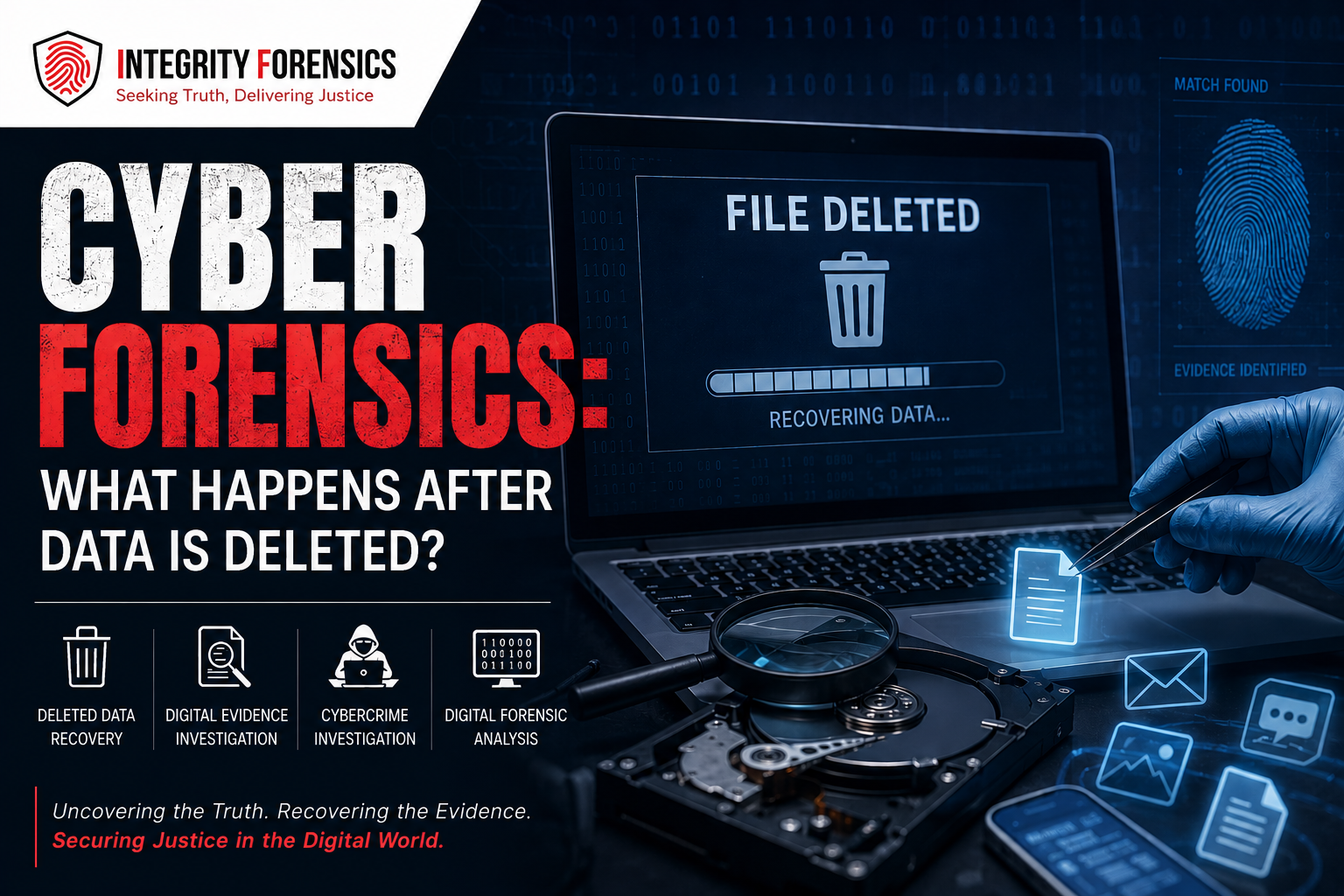
Cyber Forensics: What Happens After Data Is Deleted?
Introduction
Many people believe that once a file is deleted, it disappears forever. Whether it’s a photograph, email, document, chat message, or financial record, pressing the “Delete” button often creates the impression that the data is permanently erased. However, in the world of cyber forensics, the reality is very different.
Deleted data often leaves behind traces that can be recovered, analyzed, and used as evidence during investigations. Cyber forensic experts specialize in uncovering these digital footprints to reconstruct events, identify suspects, and support legal proceedings.
As cybercrime continues to grow worldwide, understanding what happens after data deletion has become increasingly important for individuals, businesses, and law enforcement agencies alike.
What Is Cyber Forensics?
Cyber forensics, also known as digital forensics, is the scientific process of identifying, collecting, preserving, analyzing, and presenting digital evidence from electronic devices.
Investigators examine data from:
- Computers and laptops
- Smartphones and tablets
- External storage devices
- Cloud platforms
- Network systems
- Social media accounts
- Email servers
The primary goal is to recover and interpret digital evidence while maintaining its integrity for potential use in court.
Does Deleting a File Actually Remove It?
Surprisingly, deleting a file rarely removes it immediately from a storage device.
When a file is deleted, the operating system typically removes only the reference or pointer that tells the computer where the file is stored. The actual data often remains on the storage medium until new information overwrites it.
Think of it like removing a book from a library catalog. The book may still be sitting on the shelf, but the catalog no longer shows where it is located.
This is why cyber forensic specialists can often recover files that users believe have been permanently erased.
What Happens When You Delete Data?
The deletion process generally follows these steps:
1. File Reference Is Removed
The operating system marks the file as deleted and removes its entry from the file system.
2. Storage Space Becomes Available
The area containing the deleted file is marked as free space that can be reused for future data.
3. Data Remains Temporarily Intact
Until new information overwrites the storage sectors, much of the original file may still exist.
4. Digital Traces Persist
Metadata, system logs, temporary files, cache records, and backups may continue to contain information about the deleted file.
These residual traces are valuable sources of evidence during forensic investigations.
How Do Cyber Forensic Experts Recover Deleted Data?
Cyber forensic investigators use specialized tools and methodologies to locate and reconstruct deleted information.
File Carving
File carving involves searching storage devices for recognizable file signatures and recovering files even when their original directory structure has been removed.
Recovery of Unallocated Space
Deleted files often reside in unallocated disk space. Forensic software scans these areas to identify recoverable data.
Analysis of System Metadata
Metadata provides information such as:
- Creation dates
- Modification dates
- Access times
- File ownership details
This information helps investigators establish timelines and user activity.
Examination of Backup Files
Data that appears deleted may still exist in:
- Automatic backups
- Cloud synchronization records
- Recovery partitions
- System restore points
Memory and Cache Analysis
Temporary files, browser caches, and system memory can reveal evidence that users believed had disappeared.
Can Permanently Deleted Data Be Recovered?
The answer depends on several factors.
Recovery is often possible when:
- The storage sectors have not been overwritten.
- The deletion occurred recently.
- Backup copies still exist.
- Fragments of the file remain intact.
Recovery becomes difficult or impossible when:
- Data has been securely wiped.
- Multiple overwrite processes have occurred.
- Storage sectors have been extensively reused.
Even in cases where complete recovery is impossible, forensic experts may still extract partial information that provides valuable investigative leads.
The Role of Deleted Data in Cybercrime Investigations
Deleted files frequently play a critical role in digital investigations.
Cyber forensic professionals may recover:
Fraudulent Documents
Financial records, invoices, and transaction histories can reveal evidence of fraud.
Deleted Communications
Emails, chat logs, and messages often provide insight into criminal activities.
Intellectual Property Theft
Deleted files may contain stolen business information, trade secrets, or confidential documents.
Insider Threat Evidence
Employee actions can be reconstructed through recovered digital artifacts.
Malware and Cyberattack Traces
Attackers often attempt to delete evidence after compromising systems. Forensic analysis helps uncover these hidden traces.
Challenges in Recovering Deleted Data
Although modern forensic tools are powerful, investigators face several challenges:
Solid-State Drives (SSDs)
Many SSDs use TRIM technology, which automatically clears deleted data more efficiently than traditional hard drives.
Encryption
Strong encryption can prevent access to recovered files without the appropriate credentials.
Secure Deletion Software
Programs specifically designed to overwrite data can significantly reduce recovery opportunities.
Cloud Environments
Data stored across multiple servers and jurisdictions may present legal and technical complexities.
Despite these challenges, experienced cyber forensic analysts often uncover alternative sources of evidence.
Why Cyber Forensics Matters
In today’s digital world, nearly every activity leaves behind electronic traces. Understanding what happens after data deletion is essential because critical evidence may still exist even when someone attempts to conceal it.
Cyber forensics helps:
- Investigate cybercrime
- Recover lost information
- Detect insider threats
- Support legal proceedings
- Protect organizational assets
- Establish digital timelines
- Verify or refute claims
By uncovering hidden evidence, cyber forensic investigations contribute significantly to truth-seeking and justice.
Conclusion
Deleting a file does not necessarily mean it is gone forever. In many cases, the data remains on a device long after it appears to have been removed. Through advanced recovery techniques and scientific analysis, cyber forensic experts can uncover deleted information, reconstruct digital events, and reveal critical evidence.
As cybercrime becomes increasingly sophisticated, the ability to recover and analyze deleted data remains one of the most powerful tools in modern digital investigations. Whether supporting criminal cases, corporate inquiries, or incident response efforts, cyber forensics continues to play a vital role in uncovering the hidden stories that digital devices leave behind.
At Integrity Forensics, our cyber forensic specialists leverage advanced investigative techniques to recover digital evidence, analyze cyber incidents, and support organizations in their pursuit of truth, security, and justice.

