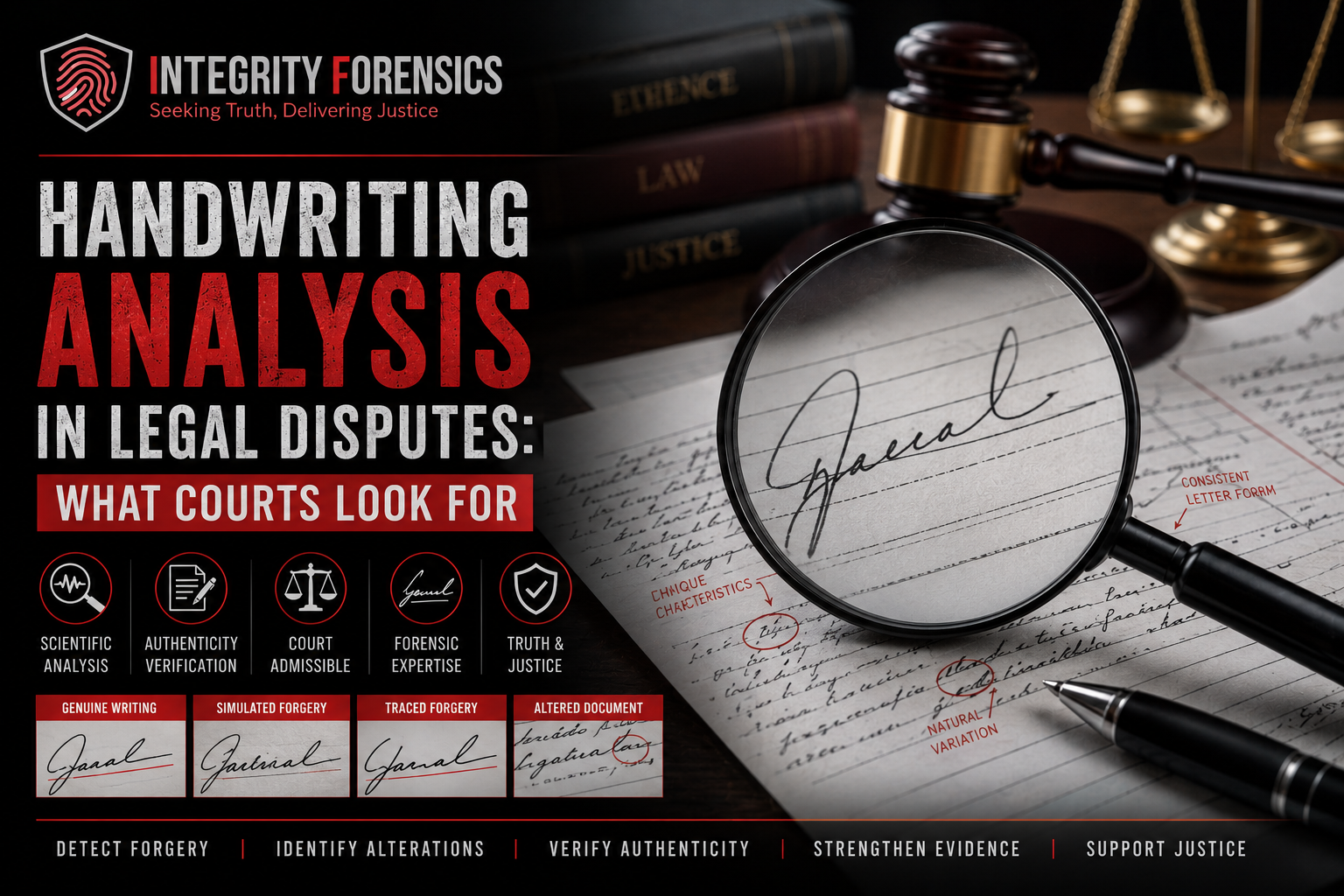
Handwriting Analysis in Legal Disputes: What Courts Look For
Introduction
Handwriting is one of the most personal and distinctive forms of human expression. Every individual develops unique writing habits through years of practice, making handwriting a valuable source of evidence in legal and forensic investigations. Despite the rapid shift toward digital documentation, handwritten documents continue to play a significant role in financial transactions, property agreements, wills, contracts, personal correspondence, and numerous legal proceedings.
When the authenticity of a handwritten document is challenged, courts often rely on forensic handwriting analysis to establish the truth. Whether the dispute involves a contested signature on a cheque, a disputed will, an anonymous threatening letter, or allegations of document forgery, handwriting examination can provide critical evidence that helps judges and investigators reach informed conclusions.
Forensic handwriting analysis is not based on guesswork or subjective opinion. It is a scientific process involving the examination and comparison of handwriting characteristics to determine authorship, identify alterations, and detect forgery. Through detailed analysis of writing habits and individual characteristics, forensic document examiners help courts distinguish genuine writing from fraudulent or manipulated documents.
This article explores the role of handwriting analysis in legal disputes, the scientific principles behind handwriting examination, what courts look for when evaluating handwriting evidence, and the significance of expert testimony in judicial proceedings.
Understanding Forensic Handwriting Analysis
Forensic handwriting analysis is a specialized branch of questioned document examination that focuses on determining the authorship and authenticity of handwritten material.
The primary objective is to answer questions such as:
- Did a particular person write the document?
- Is the handwriting genuine or forged?
- Has the document been altered?
- Were multiple writers involved?
- Was the writing intentionally disguised?
To answer these questions, forensic document examiners compare questioned writing with known handwriting samples obtained from the suspected writer.
The analysis is based on the principle that while many people may share certain writing features, no two individuals possess the exact same combination of handwriting characteristics.
Why Handwriting Matters in Legal Disputes
Handwritten documents frequently become central pieces of evidence in both civil and criminal cases.
Property and Real Estate Disputes
Disagreements often arise regarding:
- Property transfer deeds
- Sale agreements
- Lease agreements
- Ownership documents
The authenticity of handwritten entries and signatures can determine the outcome of such disputes.
Will and Testament Cases
Disputed wills frequently involve allegations that:
- A signature was forged
- The document was altered
- The testator did not write specific portions
Handwriting analysis helps establish whether the document reflects the genuine intentions of the deceased.
Banking and Financial Fraud
Financial institutions often seek forensic examination in cases involving:
- Forged cheques
- Fraudulent loan applications
- Unauthorized transactions
- Altered financial documents
Criminal Investigations
Handwriting evidence can assist investigators in cases involving:
- Anonymous letters
- Threatening communications
- Extortion notes
- Suicide notes
- Fraudulent documents
Employment and Corporate Disputes
Organizations may require handwriting analysis when investigating:
- Internal fraud
- Forged approvals
- Altered records
- Disputed employment documents
The Scientific Basis of Handwriting Analysis
Handwriting is considered a behavioral characteristic rather than a physical characteristic.
Writing is controlled by a combination of:
- Neuromuscular coordination
- Motor skills
- Learned habits
- Individual writing practices
Over time, these factors produce unique writing patterns that become largely subconscious.
Because handwriting develops through repeated practice, writers tend to exhibit consistent habits even when attempting to disguise their writing.
Forensic document examiners study these recurring characteristics to determine authorship and authenticity.
What Courts Look for in Handwriting Evidence
Courts do not simply compare handwriting based on visual appearance. Instead, they consider scientific examinations conducted by qualified forensic experts.
Several factors influence the reliability and admissibility of handwriting evidence.
Individual Characteristics
One of the most important aspects examined is the presence of individual handwriting characteristics.
These include:
- Letter formations
- Stroke construction
- Connecting strokes
- Loops and curves
- Pen lifts
- Slant
- Spacing
- Size relationships
The greater the number of consistent individual characteristics shared between questioned and known writing, the stronger the evidence of common authorship.
Natural Variation
No individual writes exactly the same way every time.
Natural variation may occur due to:
- Writing speed
- Writing position
- Fatigue
- Stress
- Health conditions
- Writing instruments
Courts recognize that genuine handwriting naturally varies. Therefore, forensic experts focus on identifying fundamental similarities rather than expecting exact duplication.
Line Quality
Line quality refers to the smoothness and fluency of writing strokes.
Genuine handwriting generally displays:
- Natural rhythm
- Continuous movement
- Consistent flow
Forged writing often reveals:
- Hesitation
- Tremors
- Slow execution
- Irregular stroke quality
Line quality is one of the most valuable indicators of authenticity.
Writing Speed and Rhythm
Writing rhythm reflects the writer’s habitual movements.
Natural writing tends to be:
- Fluid
- Confident
- Automatic
When someone attempts to imitate another person’s handwriting, the process often becomes slow and deliberate, creating noticeable disruptions in rhythm.
Courts frequently consider writing speed and rhythm as significant indicators during handwriting evaluations.
Pen Pressure
The amount of pressure applied during writing creates distinctive patterns.
Experts analyze:
- Stroke thickness
- Ink distribution
- Pressure variations
Inconsistent pressure patterns may indicate simulation or forgery.
Spacing and Alignment
Forensic document examiners evaluate:
- Letter spacing
- Word spacing
- Margin habits
- Baseline alignment
These characteristics often remain remarkably consistent in genuine handwriting.
Letter Formation
The way an individual forms letters is often highly distinctive.
Experts assess:
- Beginning strokes
- Ending strokes
- Curves
- Angles
- Loops
- Relative proportions
Even skilled forgers frequently struggle to replicate these subtle characteristics accurately.
Collection of Handwriting Samples
The reliability of forensic examination depends heavily on the quality of comparison material.
Known handwriting samples generally fall into two categories:
Admitted Writings
These are documents that are unquestionably written by the suspected author.
Examples include:
- Personal letters
- Official forms
- Previous agreements
- Bank records
Request Writings
These samples are collected specifically for examination purposes under controlled conditions.
Experts often request multiple writing samples to capture natural variation.
Courts prefer sufficient and representative comparison material before drawing conclusions.
Detecting Forgery Through Handwriting Analysis
One of the primary roles of forensic handwriting examination is identifying forgery.
Simple Forgery
A person writes another individual’s name without attempting imitation.
Such forgeries are usually easy to detect.
Simulated Forgery
The forger attempts to copy genuine handwriting or signatures.
Indicators include:
- Tremors
- Hesitations
- Poor line quality
- Slow writing
Traced Forgery
The writing is produced by tracing an original document.
Common signs include:
- Indentation marks
- Retouching
- Uneven pressure
- Lack of natural variation
Disguised Writing
A writer intentionally alters their handwriting to conceal authorship.
Despite attempts at disguise, underlying writing habits often remain detectable.
Role of Forensic Document Examiners
Forensic document examiners are trained specialists who apply scientific methods to handwriting analysis.
Their responsibilities include:
- Examining questioned documents
- Comparing handwriting samples
- Identifying alterations
- Detecting forgery
- Preparing forensic reports
- Providing expert testimony
Their findings assist courts in understanding technical evidence that may otherwise be difficult to interpret.
Expert Testimony in Court
The role of the forensic handwriting expert extends beyond laboratory examination.
Experts frequently appear before courts to:
- Explain examination procedures
- Present findings
- Demonstrate comparisons
- Clarify technical terminology
- Respond to cross-examination
Judges and lawyers rely on expert testimony to understand the significance of handwriting evidence.
A well-supported forensic opinion can greatly influence the outcome of a legal dispute.
Limitations of Handwriting Analysis
Although handwriting analysis is a valuable forensic tool, it is not without limitations.
Challenges may include:
Insufficient Comparison Material
Limited known samples can restrict the strength of conclusions.
Poor Document Quality
Photocopies and scanned documents may obscure important details.
Health-Related Changes
Conditions such as:
- Parkinson’s disease
- Stroke
- Arthritis
- Neurological disorders
can significantly affect handwriting characteristics.
Intentional Disguise
Writers may deliberately alter their handwriting to avoid identification.
Forensic experts consider these factors when forming opinions.
Importance of Handwriting Analysis in Modern Justice Systems
Despite increasing digitization, handwritten documents continue to play a critical role in legal and financial matters.
Forensic handwriting analysis helps:
- Detect fraud
- Resolve disputes
- Verify document authenticity
- Protect financial institutions
- Support criminal investigations
- Assist courts in reaching fair decisions
The discipline remains an essential component of questioned document examination worldwide.
Future of Handwriting Examination
Modern forensic laboratories increasingly combine traditional examination methods with advanced technologies.
Emerging tools include:
- Digital imaging systems
- Computer-assisted handwriting comparison
- Artificial intelligence applications
- High-resolution microscopy
- Automated measurement software
These technologies enhance accuracy while supporting expert interpretation.
However, professional judgment remains indispensable because handwriting examination involves understanding complex behavioral characteristics that technology alone cannot fully evaluate.
Conclusion
Handwriting analysis continues to serve as a powerful forensic tool in legal disputes, providing valuable insights into document authenticity, authorship, and forgery. Through the scientific examination of writing characteristics such as line quality, letter formations, spacing, pen pressure, and rhythm, forensic document examiners help courts distinguish genuine writing from fraudulent or altered documents.
Whether the dispute involves a contested will, a forged cheque, an anonymous letter, or a property agreement, handwriting evidence can significantly influence judicial outcomes. Courts rely on qualified experts to interpret these characteristics and provide objective, scientifically supported opinions.
As fraud techniques become increasingly sophisticated, the importance of forensic handwriting analysis continues to grow. By uncovering the truth hidden within handwritten documents, forensic experts play a crucial role in protecting individuals, organizations, and the justice system itself.

